
How to Retake the Florida Bar Exam: The Blueprint

In this article
Failing the Florida Bar Exam isn’t the end of the story — it’s the moment where the story becomes yours again.
A retake forces clarity. It makes you confront what didn’t work, take ownership of your approach, and decide how you want to show up for this next attempt.
Part One sat with the reality of that moment — the pressure, the timing, the finances, the expectations, and the emotional fallout no one talks about.
But once you move through that and make the decision to retake, the question shifts from “Why did this happen?” to “What’s the plan?”
That’s where this Blueprint comes in.
This is where intention replaces panic. Where structure replaces guessing.
And where “A → When → What” gives you a focused way to study differently, rebuild your plan, and aim for a different outcome on your next attempt.
Start with A – Assess
Before you build a new plan, you need to understand what actually happened last time — not from emotion, but from data.
A focused assessment gives you the understanding you need to study differently and raise your score.
Start with three areas: your score report, your process, and your learning style.
Score Report Review
Start by looking at your score report and identifying where the points were lost.
This is where most people guess — but guessing is how you repeat the same outcome.
If you failed Part A (Florida):
Ask yourself:
- Were your essays consistently lower than your FL multiple-choice?
- Did one subject area weigh your score down more than others?
- Were your weaker areas predictable (e.g., Florida Civil Procedure, Evidence, Wills)?
If you failed Part B (MBE):
Look at two things:
- Was your MBE score close to 136, or were you further from the cutoff?
- Do you see patterns in the national percentile chart — one subject significantly low, or several moderate weaknesses?
This isn’t about judgment. It’s about getting real with what happened.
Your score report tells a story, and you need an honest read on it before you you move forward with a new plan.
Example: How to Read Your FL Bar Exam Score Report
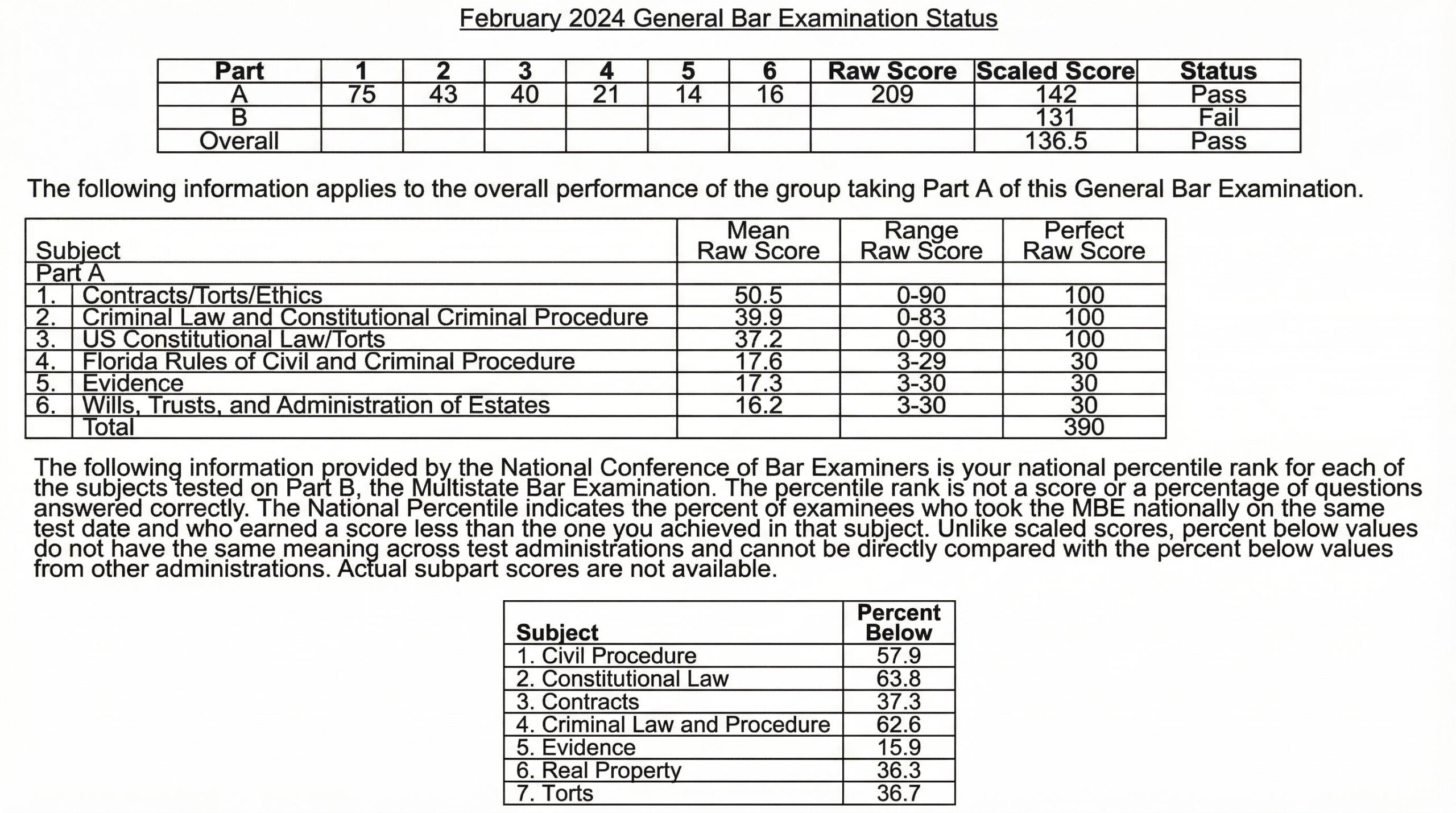
Here’s a publicly shared Florida Bar Exam score report (identifying details removed).
Let’s walk through what it shows.
In this example, the student passed Part A comfortably. Florida essays and Florida multiple-choice were strengths.
But Part B tells a different story — the MBE score came in below the passing threshold.
If you look at the national percentile chart, you’ll see:
- One major weakness: Evidence
- Three moderate inconsistencies: Contracts, Real Property, and Torts
- A few subjects fairly stable: Constitutional Law, Civil Procedure, Criminal Law & Procedure
This example makes it clear where the points were lost — and just as importantly, where they weren’t.
Instead of “I failed the MBE,” the picture becomes clearer:
- which subjects dragged the score down
- which areas were average but not enough
- which subjects were already stable
Once the problem is identifiable, it becomes fixable.
Most people never look at their report this way, which is why their score doesn’t move.
But when a report is broken down like this, the study plan that follows becomes far more intentional.
Quick Assessment Checklist
- 📝 Identify which part you failed (A, B, or both)
- 📊 Highlight the weakest subjects
- ⚖️ Mark “average but not enough” subjects
- ⭐ Circle existing strengths
- 🎯 Identify what would give you the fastest score jump
Process Audit (Last Time → What Worked → This Time)
Once you understand where the points were lost, the next step is looking at how you studied.
A lot of people skip this part, but it’s one of the biggest reasons scores don’t move. If your process doesn’t change, your result won’t either.
Think of this as a quick, honest audit of what you did last time and what needs to shift now.
Last Time — What You Actually Did
Write down the reality of your last study cycle:
- How many hours were you truly studying per week?
- What were your main study methods? (videos, outlines, practice questions, lectures)
- How consistent were you?
- Did life, work, or stress directly interfere with your routine?
- What materials did you actually use — not what you planned to use?
Think of this as your starting point. The more honest you are here, the more effective your retake strategy becomes.
What Worked — What Clearly Helped You
Not everything from your last cycle was wrong. Identify the pieces that moved your score:
- Did MBE sets help you improve?
- Did timed Florida essays help you see patterns?
- Did breaking subjects into daily rules help your retention?
- Did simplifying your materials reduce confusion?
When you recognize what helped you, you’re no longer guessing. You’re building on strategies that already moved your score.
This Time — What You’re Going to Repeat, Change, or Stop
This is where your new plan takes shape.
Decide:
- Repeat → the habits and materials that worked
- Change → the areas where your strategy wasn’t strong enough
- Stop → the things that wasted time or added stress without helping
Examples:
- If you didn’t practice Florida essays last time, that changes now.
- If you only did passive studying (videos, highlighting), that stops.
- If you improved in Torts after focused practice, that repeats.
This section becomes the bridge between assessment and action — the roadmap for your study plan.
Quick Process Audit Recap
- Be honest about the routine you really had.
- Pull forward the parts that worked.
- Leave behind what didn’t serve you.
- Make clear Repeat / Change / Stop decisions.
- Set the tone for how you’ll show up this time.
Your study plan can only go so far if it works against the way you naturally learn. Before you rebuild anything, identify the learning style that helps information stick.
WHEN — When You Are Going to Study (Your Actual Schedule)
How you learn sets the method, but when you study sets the rhythm.
Your schedule has to match your energy, responsibilities, and real life. Not someone else’s routine. Not the internet’s idea of discipline.
You don’t need a 4 a.m. miracle routine.
You need a plan that fits your energy, not a calendar slot that just happens to be open.
Choose Your Study Windows (Morning, Evening, or Split)
Your best study window is the one where you can actually focus — not the one that looks good on paper.
For example:
You might have an open evening block, but if that’s when you’re mentally done for the day, it’s not your best time.
- Some people focus best in the morning.
- Some do better at night.
- Some need a split schedule because long blocks don’t stick.
Ask yourself:
- When am I mentally sharp?
- When do I naturally focus?
- When am I least likely to cancel on myself?
- When can I sustain a routine without burning out?
There’s no superior option — only the one that actually supports you.
Bottom Line: Pick the window where you actually have energy. A study schedule only works when it matches the time of day you can consistently show up.
Working full-time vs part-time vs full-study mode.
Your schedule has to reflect the reality of your life:
- Full-time workers → shorter weekday blocks + stronger weekends
- Part-time schedules → more flexibility to build weekday momentum
- Full-study mode → you don’t need endless hours; you need intentional hours
Work with the life you have, not the life you wish you had.
And yes — just because you can study full-time doesn’t mean you should.
Commit to a Weekly Structure
Once you know your best study window, decide where it lives in your week.
This isn’t about deciding what you’ll study yet — it’s simply about carving out consistent blocks during the week where studying will happen.
Example structures (not rules):
- Full-Time Study (~2 months): multiple weekday blocks + light weekend sessions
- Part-Time Study (~6 months): short weekday blocks + heavier weekends
Your job right now is simple:
Pick the spots in your week where studying actually fits — the places you can show up for repeatedly.
Lock It Into a Calendar
Once you choose your weekly structure, you need to put it somewhere you can see it. A plan only works when it’s written down and lives in a place you check every day.
Do this:
- Write your study blocks onto a real calendar (Google, Apple, paper — whatever you use).
- Assign each block to a specific time window so it’s not floating in your head.
- Mark which sessions are “must-do” for the week so you know what cannot slide.
- Keep the calendar visible — on your phone, laptop, or wall — so you’re reminded of your plan daily.
This isn’t about adding more work.
It’s about taking the structure you already built and giving it a home.
When you can see your schedule, you’re far more likely to follow it.
Set Checkpoints: 2-Week, 4-Week, and 8-Week Checkpoints
Checkpoints keep you accountable and help you adjust early if something isn’t working. These aren’t tests — they’re quick pulse checks to make sure your plan still fits your life, your energy, and your goals.
At each checkpoint (Weeks 2, 4, 6, and 8), ask yourself the same simple questions:
- Is my schedule still realistic?
- Are my study blocks working with my energy, not against it?
- Am I keeping the commitments I set, or do I need to shift them?
- Am I seeing progress in how I study — focus, consistency, recall?
- Does anything need to change so this plan continues to work for me?
The point of these checkpoints is accountability and flexibility.
It’s completely okay to reassess and adjust your plan if it no longer suits you. The best study plans evolve — they don’t stay rigid if your life or your energy changes.
Yes, I know this goes against ‘conventional’ bar prep advice. But if you’re reading this, you’ve probably realized that conventional advice wasn’t built for you — and that’s exactly why this Blueprint exists.
Now that your study structure is locked in, the final piece is deciding what goes inside those blocks to raise your score.
WHAT — What You Are Going to Study (The Substance)
Here’s exactly how to study for the Florida Bar Exam after failing — broken into the subjects and tasks that raise your score fastest.
Your schedule is set. Now you need to decide what goes into those study blocks so your time translates into points.
Start by choosing the track that matches what you failed:
Select Your Track
- If you failed Part A, your time goes toward Florida essays, Florida multiple-choice, and Florida distinctions.
- If you failed Part B, your focus shifts toward building a stronger MBE base with targeted practice and pattern review.
- If you failed both, you’ll use a blended approach that prioritizes your weakest section while keeping the stronger one warm.
The goal isn’t to study everything evenly — it’s to study the parts that give you the biggest score jump.
And here’s something most people don’t say out loud:
if you only failed Part B (the MBE), your path forward is actually more focused.
The MBE covers seven subjects — that’s it. A narrow, defined set you can get really good at.
But if you failed Part A, you’re dealing with those same seven subjects plus Florida law on top of it — distinctions, procedures, and additional subjects you can’t skip. The lift is bigger. It’s doable, but it’s broader.
So don’t beat yourself up if Part B was the issue. From a study-design perspective, it’s the cleaner path.
Identify Your Subject Priorities
Not all Florida subjects carry the same weight, and they don’t all deserve the same amount of your study time. Understanding the order saves you hours.
First, the non-negotiables.
The Florida MC Core (Always on Part A)
These show up every time in the 100-question Florida multiple-choice section:
- Florida Civil Procedure
- Florida Criminal Law & Florida Constitutional Criminal Procedure
These are mandatory. You can’t wing these. They’re guaranteed points, and they set a baseline for your Part A score.
The MBE Core Still Matters
Even if you passed Part B, the MBE subjects still matter on Part A. A lot of Florida essays pull directly from the core MBE subjects — and then layer Florida-specific rules on top.
In some cases, the essay really hinges on core MBE principles, with the Florida distinctions meant to be sprinkled in. Obviously that’s not true for something like Family Law, but think about Criminal Procedure or Constitutional Law: the backbone of your answer is still general law, with Florida distinctions added where relevant.
In certain scenarios, you can still write an average, passing Florida essay with:
- a solid MBE foundation,
- 0–2 accurate Florida distinctions,
- clear explanations of the rules, and
- proper IRAC use.
Will that give you an above-average score? Probably not.
But average absolutely gets you to passing, and people overlook how often that’s enough.
Students waste a lot of time trying to memorize every Florida nuance before they even lock down the basic rules. For a lot of subjects, the basic rule carries the essay — the Florida layer just adds precision.
How to Prioritize Remaining Florida Bar Exam Subjects
Let’s talk about where your Florida study time actually creates the biggest score jump — because not all subjects pull the same weight, and you don’t have hours to waste.
Before you judge me for this order, chillax — I’m not Miss Cleo and I don’t have a magic ball. This isn’t fortune-telling. It’s strategy based on what consistently moves scores for Florida retakers.
Here’s the order that gives you the fastest return on your time (excluded are the non-negotiables we discussed earlier):
- Florida Evidence
- Chapters 4 & 5 of the Rules Regulating The Florida Bar
Professionalism - Florida Wills
- Florida Trusts
- Family Law
- UCC Article 9
- UCC Article 3
- Business Entities
- Florida Constitutional Law
- Florida Real Property
- Florida Contracts
Why this order makes sense
The subjects at the top:
- show up more
- are predictable
- give fast, high-ROI points
Subjects like Florida Con Law, Florida Property, and Florida Contracts land lower because your MBE foundation already does most of the work. Whatever Florida-specific pieces show up are usually just sprinkles — you can layer them onto general law with whatever distinctions you remember in the moment. They take more time to learn for fewer guaranteed Florida points, so they fall later in our priority list.
Quick Notes on #2 and #3 (Ch. 4–5 and Professionalism):
You are not studying these like you’re prepping for the MPRE.
You’re learning only the commonly tested, high-frequency rules.
These are low-effort, high-yield points — basically the sprinkles on your cupcake.
Important Disclaimer: This priority list applies only if you’re taking Part A or both parts.
If you’re sitting for Part B only, you don’t need any of these Florida-specific subjects — your entire world is the seven MBE subjects.
Weekly Subject Rotation Plan
Once you know your priorities, you don’t tackle everything at once. You rotate. A rotation keeps your workload focused, prevents burnout, and makes sure every subject gets touched without overwhelming your schedule.
Here’s the idea:
You work in small clusters of subjects at a time — usually 2–3 subjects per block — and you stay with that cluster long enough to actually build retention before switching. That might mean two weeks, a week and a half, or whatever fits your life. The exact number isn’t the point. The focus is.
Each rotation should include:
- 1 high-Return on Investment (ROI) Florida subject (like Evidence, Civ Pro, Crim Pro)
- 1 medium-weight subject (Family, Con Law, Business Entities, Wills/Trusts)
- optional light MBE reinforcement for whatever overlaps
Then, once you finish that block, you switch to a new small cluster.
By the end of your study period, you’ve cycled through all your high-priority subjects without ever drowning in fourteen at once.
The goal isn’t a rigid week-by-week syllabus.
The goal is to study in focused waves so you’re always building, never scattered.
If you’re working full-time, your rotations will be longer.
If you’re studying full-time, they’ll be shorter.
The structure flexes based on your life — that’s the whole point.
Rotation is what keeps you consistent, organized, and moving forward without burning out on any one subject.
If you want, I can now rewrite the Task Types or Daily Mini-Routines sections so they align perfectly with this version.
Task Types Within Each Study Block
Your tasks depend on which part you’re sitting for.
But the structure stays simple: each block includes the work that moves the score for your exam.
Here’s the breakdown:
If You’re Taking Part A (Florida Essays + Florida MC)
Your study blocks include:
- Florida essays (timed or untimed outline — your choice)
- Florida MC sets (10–25 questions at a time)
- Rule reinforcement using your learning style:
- quick rule rewrites
- talking the rule out loud
- active recall sheets
- your own flashcards
- short summary maps or charts
You’re building rule recall + structure + pattern recognition.
If You’re Taking Part B (MBE Only)
Your blocks are centered on:
- MBE sets (33–50 timed)
- Immediate review + pattern notes
- Reinforcement that actually helps you retain it:
- flashcards
- 2–3 rule rewrites
- talking through answer choices
- mini active-recall drills
- quick concept maps if you’re visual
No essays required unless writing helps you learn.
If You’re Taking Both Parts
Same idea — just split your blocks:
- one block for Part A tasks
- one block for Part B tasks
- and reinforcement in whatever learning-style format sticks for you
This doesn’t double your workload — it just means each block has a different focus.
Why this works
Because studying isn’t just “do questions.”
It’s:
- apply the rule (essays / MCQs / MBE sets)
- reinforce the rule (your style)
- recall the rule (active, not passive)
And the reinforcement is what makes your rotation effective — it connects the work to how you actually learn.
Closing Thoughts
A retake doesn’t require reinvention. It requires intention — real structure, real consistency, and a plan built for the way you learn.
That’s why this Blueprint is built around three pieces:
- A — Assess: what happened last time, what actually helped you, and what needs to change.
- When — Your schedule: the study windows you can consistently sustain, based on your real life and energy.
- What — The substance: the subjects that raise your score fastest and the tasks that align with how you learn.
This isn’t about copying someone else’s routine or following a rigid bar course calendar.
It’s about building a plan you can actually follow — one that matches your learning style, your responsibilities, and your pace.
Use this as your baseline.
Adjust as needed.
Keep it honest.
Keep it simple.
And focus on the moves that actually shift your score.
If you want deeper breakdowns on Florida essays, distinctions, or MBE strategy, the rest of our Florida Bar Exam series goes into those topics in more detail.
Florida Bar Exam and MBE Study Guides
-
Bar Exam Preparation
Florida and MBE Ultimate Study Guide Bundle
$924.00Original price was: $924.00.$799.00Current price is: $799.00. Read more -
Bar Exam Preparation
The Ultimate Florida Bar Exam Study Guide Bundle
$441.00Original price was: $441.00.$399.00Current price is: $399.00. Read more


Best Florida Bar Exam Study Resources
- Florida Bar Exam Complete Guide
- Florida Bar Exam Bundle
- Free Study Planner
- Bar Exam Memory Tips: Memorization Made Easy
- How to Prepare Last Minute: FL Bar Exam Tips
- FL Bar Exam Evidence Privileges: What You Need to Know
- How to Study for the FL Bar Exam in 60 Days
- Succeed on the FL Bar Exam: Topics, Scoring, and More