MBE Score Analyzer for Bar Exam Retakers
Use your last MBE score to see your estimated question gap and what it’ll take to reach your target this exam cycle
MBE Score Analyzer
Enter your jurisdiction’s minimum passing MBE scaled score, your actual MBE scaled score, and the “percent below” numbers by subject. This tool gives you an estimated picture of how many questions you likely got right overall, and a subject-by-subject breakdown of estimated questions correct, strength, and how far each subject may be from a passing-level target.
Percent below (0–100) by subject:
Use the “% below” values from your score report for each MBE subject. If a subject isn’t listed on your report, you can leave it blank.
Frequently Asked Questions
What is the purpose of the MBE Score Analyzer?
This tool helps you make sense of your MBE score report. It takes your scaled score and the “percent below” numbers and turns them into a clear, practical picture of:
about how many MBE questions you likely answered correctly overall,
which subjects were helping you or hurting you, and
how far that performance was from the minimum passing MBE score in your jurisdiction.
The goal isn’t to guess your exact raw score—NCBE doesn’t release those.
We aim is to provide you with a straightforward, honest breakdown you can actually use to plan your next steps.
Who should use this MBE score analyzer?
This tool is built specifically for repeat takers who received their MBE score report and want a clear explanation of what their results actually mean.
When you fail the bar exam or fall short on the MBE, your score report typically gives you only two pieces of information:
one scaled MBE score, and
percent-below values for each MBE subject.
Most repeat takers are handed these numbers without any guidance on how to interpret them.
It shouldn’t feel like decoding a secret chart.
This tool helps you understand:
what your one scaled score roughly translates to in questions correct,
what your percent-below numbers indicate about strengths and weaknesses across subjects, and
how far your performance was from the minimum passing MBE score required in your jurisdiction.
If you have your MBE results in front of you and want a straightforward, practical breakdown—not guesswork—this tool was built for you.
Why is this type of calculator controversial?
The MBE score report gives repeat takers very little information to work with, and the NCBE does not release raw scores. Because of that, most companies avoid offering any kind of breakdown or estimate. They don’t want to deal with conversions, percent-below interpretation, or explaining what the numbers might actually indicate for a repeat taker.
What makes this tool controversial is that it addresses a gap the bar prep world has largely ignored. It takes the limited data you do receive and organizes it into a format that helps you understand your overall position and your subject-level performance in a realistic, structured way.
For many repeat takers, this kind of clarity matters. When you can see:
-
where you likely stood on the spectrum of performance,
-
what your jurisdiction’s minimum passing MBE score represents in practical terms, and
-
which subjects may be contributing most to your gap,
it becomes much easier to design a focused, achievable roadmap for improvement.
And yes — you should take these estimates with a grain of salt. The MBE is intentionally opaque, and no tool can recreate your exact raw score.
What is the difference between a raw score and a scaled score?
Raw score:
Your raw score is the number of questions you actually answered correctly out of the 175 scored MBE questions. NCBE does not release raw MBE scores to examinees or jurisdictions.
Scaled score:
Your scaled score is the number on your score report—typically between about 40 and 200. It reflects your raw performance after NCBE applies statistical scaling (“equating”) to account for differences in difficulty across exam administrations.
This is the only score jurisdictions use to determine whether you met the minimum passing MBE score.
NCBE explains the scoring process here.
To recap:
Raw score = the actual number of questions you got right (not released).
Scaled score = the adjusted score NCBE reports (ranges from about 40–200 and is what matters for passing).
How does this tool use my actual MBE scaled score?
Your actual MBE scaled score is the only concrete number the NCBE gives you, so it’s the starting point for the entire analysis. The tool converts that scaled score—which typically ranges from about 40 to 200—into a simple estimate of how many of the 175 scored MBE questions you likely answered correctly.
This estimate isn’t meant to recreate your exact raw score. NCBE does not release raw question counts.
Instead, it gives you a clear, practical sense of where your performance likely landed and how close that performance was to the level your jurisdiction considers passing.
This helps you understand your overall position before you look at the subject-by-subject breakdown.
How does the tool use my jurisdiction's minimum passing MBE score?
Your jurisdiction’s minimum passing MBE score is the benchmark you were expected to meet. This tool converts that scaled score—usually somewhere between 130 and 140, depending on the state—into a rough estimate of how many of the 175 scored MBE questions a passing-range performance typically reflects.
This gives you a clear target.
Once you know the approximate number of questions needed for a passing-level performance, the tool compares that target to your estimated number of questions correct and identifies the gap between the two.
This makes it easier to understand how far you were from the passing range and how your subject-level performance may have contributed to that gap.
How does the tool use my "percent below" numbers?
Your “percent below” numbers show the percentage of examinees you outperformed in each subject. They are not accuracy percentages and they do not tell you how many questions you got right. But they do show whether your performance in that subject was relatively strong, average, or weak compared to everyone else who took the exam.
This tool uses your percent-below numbers to place each subject into a performance band (Strong, Solid, Needs Tightening, Weak, or Critical). Each band is then mapped to an estimated range of questions correct out of the 25 scored questions in that subject. The goal isn’t to give you exact raw numbers—NCBE doesn’t release those—but to give you a realistic sense of which subjects likely supported your score and which ones may have held you back.
This makes it easier to identify the subjects where improvement will have the biggest impact moving forward.
Can this tool tell me exactly how many questions I missed?
No. And to be clear, no tool can.
The NCBE does not release raw MBE scores or item-level data—not to examinees, not to jurisdictions, not to bar prep companies. Because of that, it’s impossible to know the exact number of questions you answered correctly in each subject.
What this tool does is take the two pieces of information you are given—your scaled score and your percent-below numbers—and turn them into practical estimate ranges. These ranges help you understand the overall shape of your performance and which subjects may have contributed most to your results.
The purpose isn’t to recreate your raw score. It’s to help you interpret the limited data you receive in a way that actually supports your next steps.
How accurate are these estimates?
These estimates are meant to be reasonable approximations, not exact reconstructions. Because the NCBE doesn’t release raw scores or subject-level accuracy, any tool that attempts to interpret your MBE report has to work within the limits of the data you receive.
The conversions used here follow the same general approach bar prep programs use when discussing scaled scores, performance ranges, and percentile meaning. They’re not precise, but they give you a clear sense of:
your approximate position on the exam,
how close your performance was to a passing-range score, and
which subjects were likely stronger or weaker for you.
Think of this tool as a way to translate an otherwise unclear score report—not as a way to calculate exact numbers. The value is in the direction and insight it provides, not in perfect numerical accuracy.
How did you determine my strength for each subject?
Each strength label—Strong, Solid, Needs Tightening, Weak, or Critical—is based entirely on your percent-below number for that subject. Your percent-below value shows the percentage of examinees you outperformed in that subject. Higher percentiles indicate stronger performance relative to other test takers.
To keep the categories simple and easy to interpret, the tool uses broad percentile ranges:
Strong: 75% and above
Solid: 60% to 74.9%
Needs Tightening: 40% to 59.9%
Weak: 25% to 39.9%
Critical: below 25%
These bands are not raw accuracy scores. They’re a way to translate your percentile into a practical snapshot of how you performed in each subject relative to the national pool.
The goal is to give you a straightforward picture of which subjects likely supported your overall score and which ones may have contributed to your gap—so you know where your study time will have the biggest impact moving forward.
What if I’m seeing a glitch or have feedback about the tool?
If something isn’t working the way you expect, or if you have feedback that could make this tool more helpful, we’d love to hear it. This calculator is still evolving, and real user input helps us refine it and keep it accurate and stable for repeat takers.
If your jurisdiction provides any additional MBE data beyond the scaled score and percent-below numbers, we’d also appreciate you sharing that with us. Different states release information in different formats, and that insight helps us continue improving the analyzer for everyone.
You can reach us anytime at support@ameribrights.com or through the contact form on our site. Screenshots or a brief description are helpful, but not required.
Can I realistically improve my MBE score?
Absolutely. With the right structure and focused practice, most repeat takers make meaningful, measurable improvement. The MBE isn’t fixed—you can train for it the same way you train any skill.
A big part of that process is mindset. There’s a strong probability you can do far more than you think. In law school and in life, the biggest barriers are often the beliefs we hold about ourselves—the invisible limits we assume are real when they’re not.
If you want help identifying exactly what to fix—timing, rule recall, question strategy, or stress patterns—check out our MBE Self-Assessment Tool. It walks you through a short diagnostic so you can build a focused plan that actually moves your score.
What is the purpose of the MBE?
The Multistate Bar Examination (MBE), administered by the National Conference of Bar Examiners (NCBE), is designed to measure whether you can consistently apply core legal principles in the same way licensed attorneys must in real practice.
It tests your ability to analyze, reason, and choose the legally accurate outcome across seven subjects that every jurisdiction considers foundational.
Because the MBE is standardized nationally, it also provides a uniform benchmark that allows jurisdictions to compare examinee performance fairly, regardless of which law school you attended or which state you’re taking the exam in.
You can learn more about the exam directly from the NCBE here.
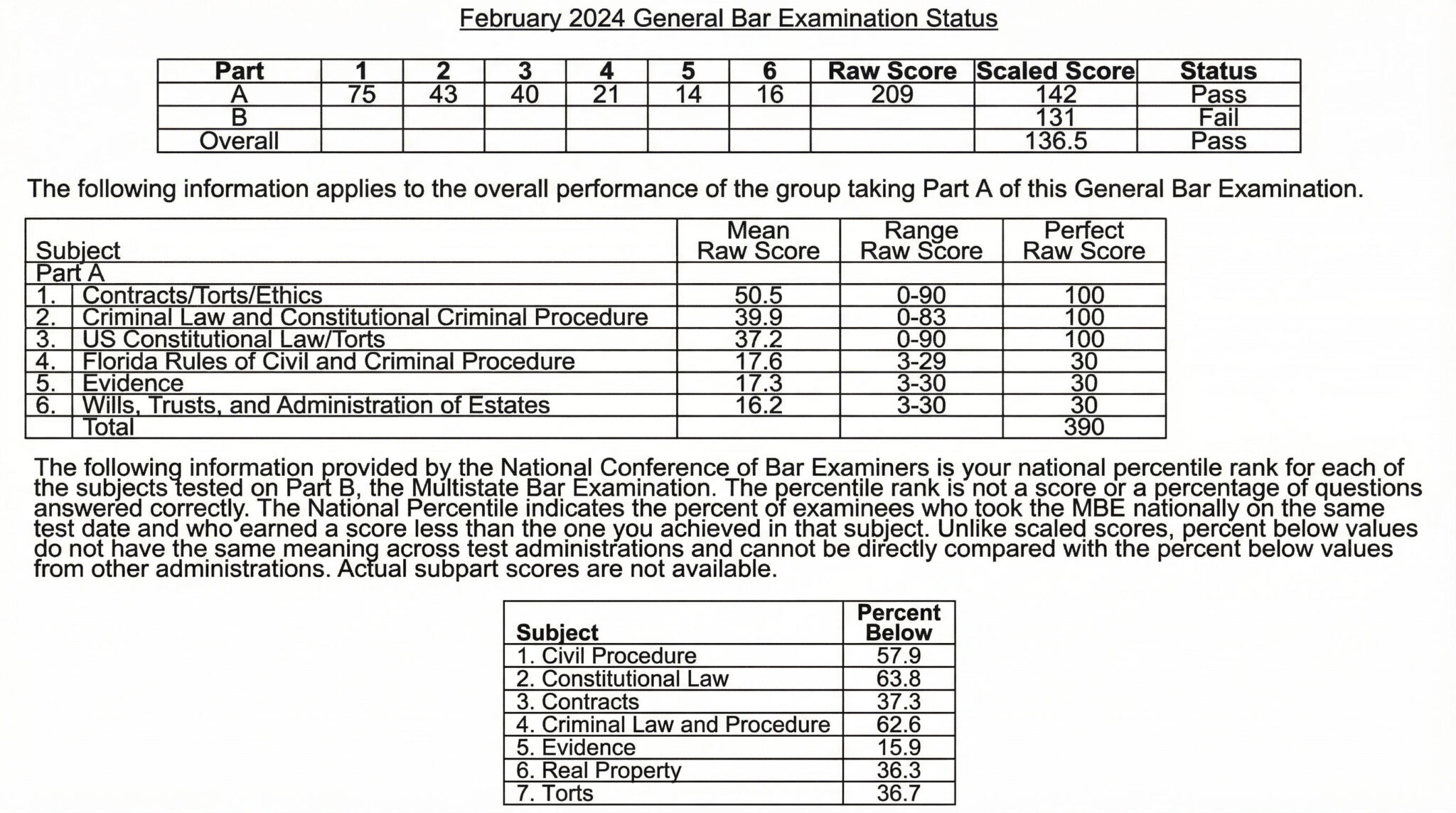
What Your MBE Score Looks Like (Florida Example)
This is an example of what a FL Bar Exam score report looks like. The table at the bottom (“Percent Below”) is the part our analyzer helps you interpret.
Even though this example is from Florida, the analyzer works for any jurisdiction that provides your scaled MBE score and subject-level percent-below values. Your actual report may use a different layout depending on your state, but the underlying data is the same.