
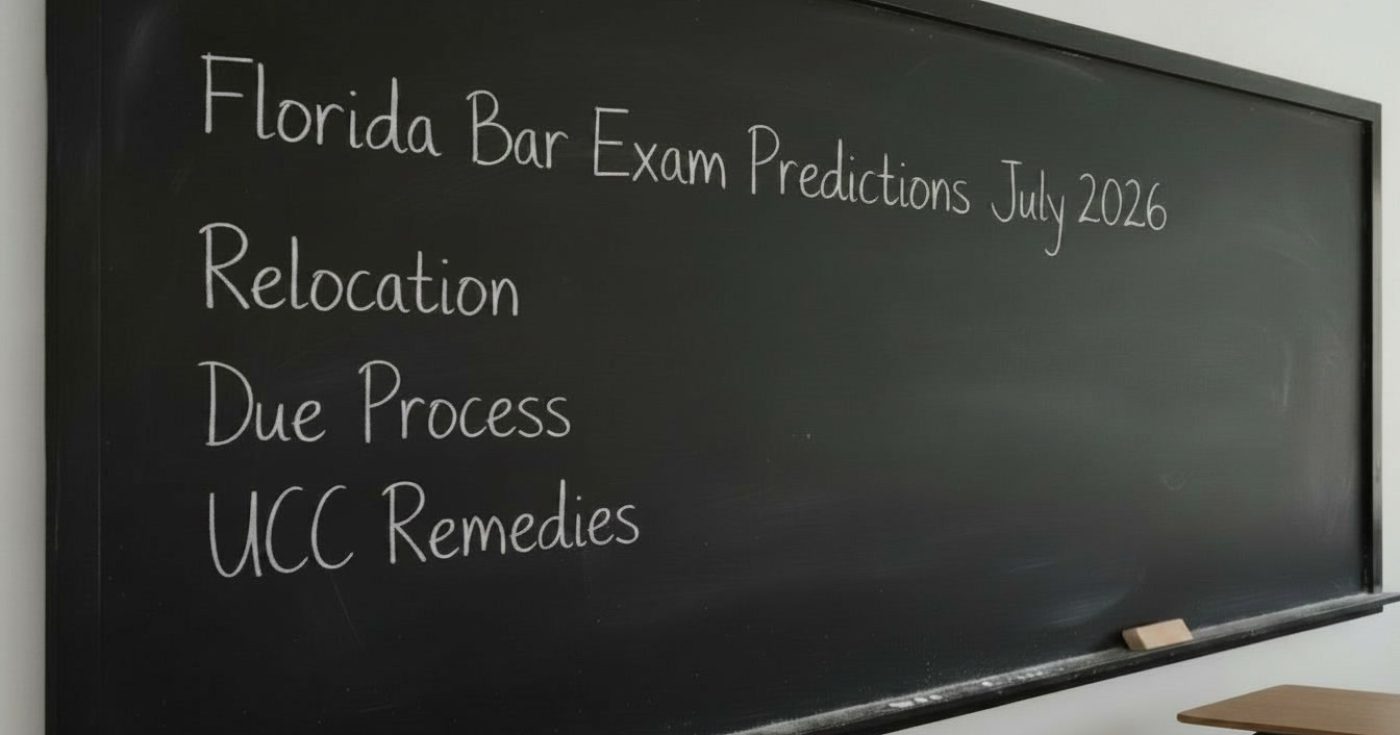
Florida Bar Exam Essay Predictions July 2026
Final Weeks? Simplify Florida Law Before July
If your commercial bar prep course still feels too broad or overwhelming, our Florida-focused guides are designed to help you narrow your attention to the rules, distinctions, and essay patterns that matter most during the final stretch.
In this article
Preparing for the Florida Bar Exam means learning how to prioritize. The essay portion rewards more than memorization alone — it rewards pattern recognition, strategic preparation, and understanding how the Florida Board of Bar Examiners tends to rotate subjects and structure crossover fact patterns over time.
While no one can predict the exact essays that will appear in July 2026, historical testing patterns still matter. We analyzed more than a decade of Florida essay data, focusing not only on subject frequency, but also on omissions, rotational trends, crossover combinations, and the specific procedural “lanes” the Board repeatedly returns to in different administrations.
The Florida essay landscape has also changed in recent years. With subjects like Business Entities, Trusts, Secured Transactions, and Commercial Paper shifting away from essay testing, the remaining essay pool has become narrower — making rotational patterns and historical gaps even more important when evaluating likely topics.
This July 2026 prediction guide highlights the subjects, crossover structures, and subareas that appear most likely based on recent administrations and long-term testing trends. These predictions are not meant to replace comprehensive preparation, but to help you study more strategically, strengthen weak areas, and focus your final weeks with greater clarity and intention.
Prediction 1: Family Law (Post-Judgment Modification / Jurisdiction / Relocation)
Family Law remains one of the most consistently tested Florida Bar Exam essay subjects, but the Florida Board of Bar Examiners (the Board) rarely repeats the same type of Family Law essay in consecutive administrations. Over time, the examiners have shifted between several recurring frameworks, including dissolution/support frameworks, post-judgment modification disputes, adoption/TPR issues, equitable distribution analysis, and custody scenarios.
More recent administrations already tested adoption/TPR issues (July 2023), equitable distribution and alimony analysis (July 2024), and broader dissolution/custody disputes involving tort and property crossover issues (February 2025). That leaves one of the Board’s most historically reliable Family Law frameworks comparatively dormant in recent cycles: post-judgment modification, relocation, and interstate jurisdiction disputes involving parenting plans and continuing court authority.
What to expect:
A post-judgment Family Law dispute involving modification of an existing parenting plan, relocation, or interstate jurisdiction issues. The fact pattern will likely raise issues connected to:
- Substantial change in circumstances (material, substantial, and unanticipated change)
- Parenting plan modification (best interests; parental responsibility; time-sharing adjustments)
- Relocation restrictions (statutory relocation factors; long-distance move; burden shifting)
- UCCJEA jurisdiction (home-state analysis; continuing jurisdiction; emergency jurisdiction)
- Child support modification (income changes; substantial change; retroactive support issues)
- Enforcement and contempt (failure to comply with parenting plans or support obligations)
- Attorney’s fees (need and ability to pay; enforcement-related fee awards)
- Interstate custody disputes (competing state authority; registration/enforcement of out-of-state orders)
- Ethics/professional responsibility crossover (conflicts; confidentiality; third-party payment issues)
Why it ranks high:
Although February 2025 involved custody, parental-responsibility, and support issues, the Board only touched lightly on the broader post-judgment modification and interstate-jurisdiction framework that appeared much more directly in July 2021. The Board has not recently centered an essay around relocation analysis, UCCJEA sequencing, continuing jurisdiction, and modification procedure as the primary procedural posture of the dispute.
That framework remains one of the Board’s strongest historical vehicles for testing multiple high-value Florida Family Law doctrines simultaneously, including continuing jurisdiction, modification standards, best-interests analysis, support modification, and interstate enforcement issues.
These essays also tend to differentiate stronger and weaker examinees because examinees frequently:
- confuse modification standards,
- improperly sequence UCCJEA analysis,
- or overlook continuing jurisdiction issues entirely.
Looking for Family Law Practice Essays? Start Here.
These are the strongest Family Law essays to practice if you want to build pattern recognition for July 2026 — especially for post-judgment modification, relocation, UCCJEA jurisdiction, support modification, and parenting-plan disputes.
Start Here First (Closest to What We’re Predicting for July 2026):
July 2021 – Parenting Plan Modification; Child Support Modification; Alimony; UCCJEA Continuing Jurisdiction (Substantial change in circumstances; best interests; interstate jurisdiction; continuing jurisdiction; modification standards; time-sharing; attorney’s fees)
Additional High-Value Family Law Essays:
- July 2024 – Equitable Distribution; Alimony; Florida Constitutional Law + Ethics (active appreciation; marital vs. nonmarital assets; durational alimony; access-to-courts/public-records analysis; sealing financial affidavits; contingency-fee restrictions in family law)
- February 2025 – Dissolution; Custody; Alimony; Equitable Distribution; Torts Crossover (car accident/negligence issues; best interests; parental responsibility; family home; alimony; settlement proceeds; marital vs. nonmarital allocation)
- July 2023 – Adoption; Termination of Parental Rights; Ethics (relative adoption; abandonment; involuntary termination of parental rights; consent and notice requirements; adult adoption; child-support arrearages after adoption; third-party payment of attorney’s fees)
- February 2021 – Dissolution; Premarital Agreements; Alimony; Equitable Distribution; Ethics (alimony-waiver provisions; validity of premarital agreements; equitable distribution of inherited assets; jurisdiction; mediation considerations; contingency-fee restrictions in family law)
- February 2019 – Trusts / Family Law Crossover (spendthrift trusts; discretionary distributions; alimony as an exception creditor; trust termination; trustee fiduciary duties; revocation issues)
- February 2017 – Trusts / Family Law / Ethics Crossover (spendthrift trusts; discretionary vs. mandatory trusts; child-support exception creditors; creditor claims against trust assets; self-settled trust issues; concurrent-client conflict analysis)
Common Family Law Essay Mistakes
Family Law essays often turn on sequencing as much as substantive law.
Stronger answers usually move methodically through the series of events — jurisdiction first, then modification standards, then best-interests analysis and enforcement issues.
Weaker answers often jump straight into custody arguments without first analyzing continuing jurisdiction, UCCJEA home-state issues, or whether the proper modification standard even applies.
On these essays, organization and issue order matter. Try not to skip the procedural framework and rush directly to the outcome.
Prediction 2: Florida Constitutional Law (Local Government Authority / Procedural Due Process)
Florida Constitutional Law remains one of the most frequently tested Florida Bar Exam essay subjects, but the Board tends to rotate between several recurring constitutional frameworks rather than repeatedly testing the exact same type of government dispute. Over the last decade, the examiners cycled through Sunshine/open-government disputes, privacy and access-to-courts analysis, municipal-authority and procedural-due-process challenges, and more recent federal constitutional crossover issues involving Equal Protection, Free Exercise, and Standing.
More recent administrations leaned heavily toward freedom-of-speech and constitutional criminal procedure issues (February 2025) and broader individual-rights analysis involving Equal Protection, Free Exercise, and Standing (July 2025). That leaves one of the Board’s strongest recurring Florida Constitutional Law themes less emphasized in recent cycles: local-government procedural disputes involving municipal authority, procedural due process, and government-action analysis similar to February 2020 and February 2022.
What to expect:
A city, county, or administrative agency adopts or enforces a regulation that creates procedural-due-process problems, government-authority disputes, and individual-rights concerns. The fact pattern may test issues involving:
- Procedural Due Process (deficient notice; lack of meaningful hearing opportunity; unfair administrative procedures)
- Local Government / Home Rule Authority (scope of municipal power; county versus state authority; preemption conflicts)
- Access to Courts (administrative barriers; limits on remedies; procedural restrictions)
- Equal Protection (unequal enforcement; arbitrary classifications; disparate treatment)
- Standing (who may challenge the government action; injury requirements)
- Municipal Ordinances / Regulatory Restrictions (licensing schemes; permitting restrictions; local enforcement powers)
- Administrative Enforcement Procedures (agency penalties; procedural irregularities; enforcement mechanisms)
- Notice and Hearing Requirements (adequate notice; opportunity to be heard; procedural fairness)
- Sunshine/Open Meetings (improper closed-door deliberations; public-records concerns; procedural violations)
- Ethics / Professional Responsibility (government-attorney conflicts; improper communications; conflicts involving public officials)
Why it ranks high:
Constitutional Law essays have repeatedly centered on disputes involving government power, procedural fairness, and challenges to local regulations. Over the last decade, the Board consistently returned to fact patterns involving municipal ordinances, administrative enforcement, access-to-courts concerns, and constitutional limits on government action when testing Florida-specific constitutional doctrine.
Although Constitutional Law appeared in July 2025, that administration leaned more heavily toward individual-rights issues rather than classic Florida local-government disputes. Historically, after administrations emphasizing broader individual-rights analysis, the Board has frequently returned to Florida-specific government-action issues involving procedural due process, municipal authority, and administrative procedure.
Several February administrations in particular show a recurring pattern involving local ordinances, notice-and-hearing issues, procedural irregularities, and challenges to government enforcement mechanisms. Given those historical trends, a Florida Constitutional Law essay centered on local government action and procedural due process remains one of the stronger candidates for July 2026.
Looking for Florida Con Law Practice Essays? Start Here.
If you want to strengthen your timing, issue sequencing, and constitutional analysis under pressure, these are the strongest recent FL Constitutional Law essays to practice — especially those involving local government authority, procedural due process, access to courts, and sunshine/open meetings issues.
Start Here First (Closest to What We’re Predicting for July 2026):
- February 2022 – Local Ordinances; Procedural Due Process; Access to Courts (charter-county authority; overbreadth challenges; forfeiture procedures; notice-and-hearing requirements; access-to-courts analysis; separation-of-powers concerns; administrative enforcement powers)
- February 2020 – Municipal Authority; Due Process; Equal Protection; Bail (sex-offender residency restrictions; substantive and procedural due process; excessive-bail challenges; equal-protection analysis; overbreadth concerns; separation-of-powers issues; local-government authority)
Additional High-Value Florida Constitutional Law Essays:
- February 2025 – Freedom of Speech; Constitutional Criminal Procedure; Privacy; Ethics (content-based restrictions; time/place/manner analysis; county ordinances; procedural due process; warrantless cellphone searches; Florida privacy protections; pretrial release/bond rights; third-party payment/confidentiality conflicts)
- July 2025 – Equal Protection; Free Exercise; Standing; Florida Constitutional Law; Ethics (case-or-controversy requirements; ripeness; alienage classifications; religious-organization exclusions; Establishment Clause versus Free Exercise analysis; Blaine Amendment issues; former-government-lawyer conflicts)
- February 2018 – Privacy; Access to Courts; Establishment Clause; Equal Protection; Right to Bear Arms (Florida constitutional privacy protections; mandatory blood draws/searches; unreasonable searches and seizures; Blaine Amendment analysis; Lemon test; access-to-courts restrictions; Kluger analysis; equal-protection challenges; takings issues; firearm-incentive legislation)
- July 2017 – Juvenile Curfew Ordinance; Sunshine Law; Privacy; Equal Protection; Ethics (municipal police powers; Sunshine/open-meetings violations; warrantless surveillance concerns; overbreadth and vagueness challenges; time/place/manner restrictions; juvenile curfew analysis; former-client conflict issues)
- February 2017 – Local Government Authority; Sunshine Law; Constitutional Officers; Defamation (charter-county powers; independent constitutional officers; government encroachment on judicial functions; subpoena powers; public-records/open-meetings requirements; privacy; media defamation standards; public-official actual malice analysis)
Common Constitutional Law Essay Mistakes
Florida Constitutional Law essays often cause examinees to hesitate because the rules can feel less “clean” than heavily memorized subjects like Torts or Contracts. Many people panic when they cannot remember an exact Florida constitutional nuance, get stuck between two possible analyses, or freeze because they know a Florida distinction exists but cannot fully recall it under pressure.
Stronger answers usually keep moving even when the rule statement is imperfect. If you recognize the core constitutional issue, identify the government action involved, explain the competing interests, and apply the most likely framework logically, you can still pick up substantial points. If you cannot fully remember the precise rule, articulate the purpose behind the doctrine instead — what problem is the rule designed to prevent, protect, or regulate?
Weaker answers often lose time trying to reconstruct the “perfect” constitutional rule instead of analyzing the facts in front of them. On these essays especially, partial rule recall with strong application is usually better than silence.
Prediction 3: Contracts (Breach / Remedies / UCC Distinctions)
Contracts remains one of the Board’s most flexible essay subjects because a single transaction can trigger formation issues, performance disputes, breach analysis, damages, equitable remedies, and UCC distinctions all within the same fact pattern. These essays often involve layered commercial disputes that require examinees to move carefully through formation, performance, breach, and remedies analysis in the correct sequence.
Although February 2026 included narrower contract-related issues tied to landlord-tenant and repair disputes, the Board did not heavily test broader Contracts doctrines involving remedies, anticipatory repudiation, warranties, or UCC-versus-common-law analysis. That leaves open the possibility of a more traditional Contracts essay centered on breach sequencing, performance problems, and damages analysis.
The strongest Contracts candidates for July 2026 likely involve a business or sales transaction that falls apart and requires examinees to work through UCC versus common-law distinctions, breach issues, modification problems, and competing damages arguments.
What to expect:
A business or consumer transaction breaks down after one party fails to perform, delivers defective goods, improperly modifies the agreement, or disputes payment obligations. The fact pattern may test issues involving:
- Material Breach (substantial performance; conditions; failure of consideration)
- UCC v. Common Law Distinctions (sale of goods versus services; merchant status; mixed contracts)
- Contract Formation (offer; acceptance; consideration; indefiniteness)
- Statute of Frauds (writing requirements; exceptions; partial performance)
- Contract Modification (UCC good-faith modifications; consideration requirements)
- Anticipatory Repudiation (clear refusal to perform; retraction; demand for assurances)
- Warranties (express warranties; implied merchantability; fitness for particular purpose)
- Damages (expectation damages; reliance damages; consequential damages; mitigation)
- Liquidated Damages (enforceability; penalty analysis)
- Assignment / Delegation (transfer of rights; delegation of duties; liability after delegation)
- Equitable Remedies (specific performance; injunctions; restitution)
- Professional Responsibility (conflicts of interest; attorney communications; handling disputed funds; representation issues arising from the underlying transaction)
Why it ranks high:
Because the most recent administration confined its contract testing to narrower landlord-tenant and repair disputes, broader UCC doctrines, layered remedies analysis, anticipatory repudiation, and commercial-performance issues remain comparatively under-tested in recent cycles. Contracts essays also give the examiners an efficient way to test multiple doctrines within a single transaction, particularly formation, breach, modification, damages, and equitable remedies.
Looking for Contracts Practice Essays? Start Here.
If you want to strengthen your timing, issue sequencing, and remedies analysis under pressure, these are the strongest recent Contracts essays to practice — especially those involving UCC formation issues, repudiation, modifications, warranties, damages, and commercial-performance disputes.
Start Here First (Closest to What We’re Predicting for July 2026):
- February 2024 – UCC Formation; Mistake; Remedies; Ethics (unilateral versus mutual mistake; anticipatory repudiation; UCC sale-of-goods analysis; merchant status; specific performance; tortious interference; third-party-beneficiary issues; attorney trust-account obligations)
- February 2023 – Battle of the Forms; Repudiation; Buyer Remedies; Ethics (UCC battle-of-the-forms analysis; additional versus conflicting terms; anticipatory repudiation; cover damages; consequential damages; limitation-of-liability clauses; merchant-confirmation rule; former-client conflict analysis)
Additional High-Value Contracts Essays:
- July 2021 – Sale of Goods; Merchant Confirmatory Memo; Perfect Tender; Liquidated Damages; Ethics (UCC formation; merchant-confirmation rule; latent ambiguity; scrivener’s error/reformation; perfect-tender rule; cure; liquidated-damages enforceability; specific performance; imputed-conflict analysis)
- October 2020 – Accord & Satisfaction; Non-Compete Agreements; Parol Evidence Rule (common-law contract formation; substantial versus material breach; accord and satisfaction; merger clauses; promissory estoppel; enforceability of non-compete agreements; restrictive-covenant reasonableness; fraudulent inducement)
- February 2020 – Employment Contracts; Non-Compete Agreements; Tortious Interference (enforceability of restrictive covenants; legitimate business interests; geographic and duration limitations; consequential damages; intentional interference with contractual relations; injunctive relief; public-figure defamation analysis)
Common Contracts Essay Mistakes
Contracts essays are often less about finding one impossible issue and more about managing a fast-moving stream of issues efficiently under time pressure. These fact patterns can contain formation disputes, modifications, warranties, repudiation, damages, defenses, and remedies all layered together very quickly.
Stronger answers usually keep moving. They identify the major issue, apply the rule cleanly, reach a conclusion, and transition to the next problem without getting trapped spending fifteen minutes on one narrow subissue. Weaker answers often slow down too much early in the essay, overanalyze minor points, and then run short on time before reaching some of the larger remedies or damages issues later in the fact pattern.
On Contracts essays especially, time management and issue pacing matter almost as much as substantive doctrine.
How to Use These Predictions in Your Study Plan
These predictions are not meant to replace full preparation. They are meant to help you study more strategically during the final stretch before the exam.
The Florida Bar Exam rewards organization, issue recognition, pacing, and the ability to apply Florida-specific rules under pressure. Use these predictions to sharpen those skills intentionally rather than trying to memorize every possible nuance perfectly.
Focus on patterns, not just subjects
Do not just memorize broad subject headings. Pay attention to the types of fact patterns the Board repeatedly returns to:
- post-judgment Family Law disputes,
- local-government procedural challenges,
- UCC formation and remedies problems,
- layered crossover essays involving ethics or jurisdiction.
The more essays you review, the more repetitive these structural patterns start to feel.
Practice moving through essays efficiently
Many Florida essays contain far more issues than you can analyze perfectly in 60 minutes. Stronger answers usually keep moving. They identify the major issue, state and apply the rule cleanly, reach a conclusion, and transition efficiently to the next issue without getting stuck trying to write the “perfect” analysis.
This is especially important in Contracts and Constitutional Law essays, where timing and issue sequencing often matter as much as deep doctrinal detail.
Train yourself not to freeze on imperfect rule recall
One of the biggest mistakes examinees make is stopping completely when they cannot remember an exact Florida rule or nuance. If you recognize the core issue, explain the purpose behind the doctrine, identify the competing interests, and apply the facts logically, you can still earn substantial points.
Partial rule recall with strong application is usually far more valuable than silence.
Use predictions to guide your final weeks
During the final 2–3 weeks before the exam, spend more time writing and outlining essays within the predicted clusters. Focus on timing, organization, transitions between issues, and identifying Florida distinctions quickly under pressure.
Predictions should shape your priorities — not create tunnel vision.
Keep the remaining subjects active
No prediction is guaranteed. Continue reviewing the remaining essay subjects enough to maintain baseline familiarity and avoid blank-page panic if the Board pivots unexpectedly.
Pair predictions with strong essay technique
Knowing what to study is only half the battle. How you organize and communicate your analysis matters just as much.
If you have not seen it yet, our guide on Writing the Best Responses for FL Bar Exam Essays breaks down Florida-specific IRAC structure, organization strategies, and what graders reward on high-scoring essays.
The Final Stretch Feels Different When Your Study Plan Finally Makes Sense
Whether you are supplementing a commercial course or studying independently, Ameribrights was designed to help make Florida bar prep feel more organized, strategic, and manageable — especially when the volume of information starts becoming difficult to control.
Important Note on Using Older Essays for Practice
Older Florida Bar essays are extremely valuable for pattern recognition, organization, and issue spotting — but not every older model answer reflects current Florida law.
Florida law changes over time, and some doctrines tested in older essays have since been modified by statute or case law. One major example is Florida’s shift from pure comparative negligence to modified comparative negligence under House Bill 837 in 2023.
When practicing older essays:
- focus heavily on structure, issue sequencing, and fact-pattern recognition,
- but always verify that the substantive rule is still current Florida law.
The FBBE model answers remain extremely useful for understanding how issues are organized and analyzed under timed conditions, but they are not updated to reflect later statutory or doctrinal changes. Use them as tools for reasoning and structure — not as automatically current statements of Florida law.
Where Ameribrights Fits In
Whether you are using a large commercial bar prep program or studying primarily on your own, one of the biggest challenges of the Florida Bar Exam is figuring out how to organize the sheer amount of information in front of you. The exam rewards much more than passive memorization — it rewards pattern recognition, issue sequencing, timing, and confident application of Florida-specific rules under pressure.
That is where Ameribrights can help. Our Florida-specific guides are designed to be comprehensive enough to support independent study while still remaining focused, streamlined, and practical for actual exam conditions. Instead of burying you in massive outlines, we emphasize highly tested Florida distinctions, crossover patterns, issue organization, essay structure, and the rules the Board repeatedly returns to in essays and multiple-choice questions. For many examinees, the biggest breakthrough comes when studying finally starts to feel organized instead of chaotic.
If you are preparing for July 2026, we also recommend reading our Florida Bar Exam Roadmap, Florida Bar Exam Scoring Explained, and Florida Multiple-Choice Trends Breakdown alongside these predictions. Together, those resources can help you understand what Florida tests, how the exam is scored, and where to focus your review as you move into the final stretch.
Final Thoughts
You do not control what appears on the Florida Bar Exam, but you do control how strategically you prepare for it. Predictions are not guarantees — they are tools to help you focus your time, recognize recurring patterns, and approach the final stretch of bar prep with more structure and intention.
The Florida essays reward more than memorization alone. They reward organization, pacing, issue recognition, and the ability to keep moving even when a rule is imperfectly recalled. In many ways, success on this exam comes from learning how to stay composed inside difficult fact patterns instead of freezing when everything feels uncertain.
Write often. Review actively.
Momentum matters. Resilience matters.
Practice moving through essays efficiently under time pressure. Focus less on perfection and more on building consistency, pattern recognition, and confidence in your analysis.
Whether this is your first attempt or a retake, you are not starting from zero. Every practice essay, every outlined issue, and every difficult study session adds another layer to your foundation. And if you need additional structure, clarity, or Florida-focused guidance along the way, Ameribrights is here to help you make each study day count.
Sign Up for Weekly Email Notifications
-
Bar Exam Preparation
Florida and MBE Ultimate Study Guide Bundle
$924.00Original price was: $924.00.$799.00Current price is: $799.00. Read more

Best Florida Bar Exam Study Resources
- The CORE System: A Better Way to Study for the Florida Bar Exam
- NorthStar: Champagne on the Asphalt (Part One) – FL Corporations
- How to Study for the FL Bar Exam in 60 Days (Without a Bar Prep Program)
- Free Study Planners
- MBE Self Assessment Tool
- How to Prepare Last Minute: FL Bar Exam Tips
- FL Bar Exam Evidence Privileges: What You Need to Know
- FL Bar Exam LLCs Explained Through A Story