
Florida Judicial Administration: What You Need to Know For The Bar Exam

In this article
Florida Judicial Administration: A Practical Reference
The problem with Judicial Administration isn’t complexity — it’s organization.
Florida limits what it tests under the Rules of Judicial Administration, but the tested areas still cut across public access to court records, minimization of sensitive information, who may appear in court, signature and certification requirements, timing rules, and judicial disqualification. When people encounter those provisions in isolation or straight from the source materials, the subject feels fragmented and easy to mismanage.
That’s why we built a consolidated Judicial Administration resource. We didn’t set out to restate the rules or create another outline. We wanted a single reference that pulls together the specific areas Florida actually tests and presents them in a way that reflects how these rules operate in real Florida court practice.
This article explains how we approach Judicial Administration, what each section of the resource focuses on, and how to use it as part of a broader Florida study plan.
Why We Teach Judicial Administration (Even When You Want to Skip It)
A lot of people approach Judicial Administration with the same mindset: this is small, unlikely to show up, and not worth serious time.
We understand where that instinct comes from. Compared to subjects like Florida Civil Procedure — with its federal versus Florida distinctions and layered nuances— Judicial Administration feels minor.
Here’s the thing, though.
Judicial Administration is one of the most straightforward areas Florida tests. The rules are direct. The questions are usually clean. And when they appear, they tend to test whether you know the basic principle or purpose — not whether you can navigate competing standards or nuanced distinctions.
That matters.
People often decide to skip Judicial Administration entirely, usually to free up time for another subject. Know this — when you sit for the Florida multiple-choice segment that includes Civil and Criminal Procedure, Judicial Administration questions are typically part of that mix. It’s not optional in practice. When you sit for that segment, Judicial Administration will be there — and skipping it doesn’t eliminate the questions, it just increases your likelihood of not getting easy points.
That’s why we don’t teach Judicial Administration as something to obsess over — but we also don’t treat it as something to ignore. When the rules are clear and the testing is direct, the goal is to recognize those questions quickly and answer them correctly.
Every point matters. Judicial Administration is one of the few areas where Florida tests straightforward rules — and those are points you shouldn’t leave on the table.
How We Approach Judicial Administration
Our Judicial Administration resource follows the rules as written.We don’t reinvent them or reorganize them into something unfamiliar.
Instead, we focus on the specific areas Florida actually tests and explain them in a way that makes the questions easier to recognize and answer.
Public Access & Confidentiality of Florida Court Records
Florida starts from a clear premise: judicial records are open to the public unless a rule, statute, or court order says otherwise. That framing matters, because Florida tests public access as the default and confidentiality as the exception.
Where people get tripped up is assuming that anything sensitive is automatically confidential. Florida doesn’t work that way. The rules distinguish between sealing a record and redacting specific information, and Florida strongly prefers redaction when it can protect confidential information without restricting access to the entire record.
In the resource document, we focus on how confidentiality actually operates procedurally — who has the authority to designate information as confidential, when notice and motion requirements apply, and why courts must apply confidentiality narrowly. Florida doesn’t appear to be testing policy here. The Board of Bar Examiners is more practical than that – they are likely testing whether you understand who controls access and how those decisions are made.
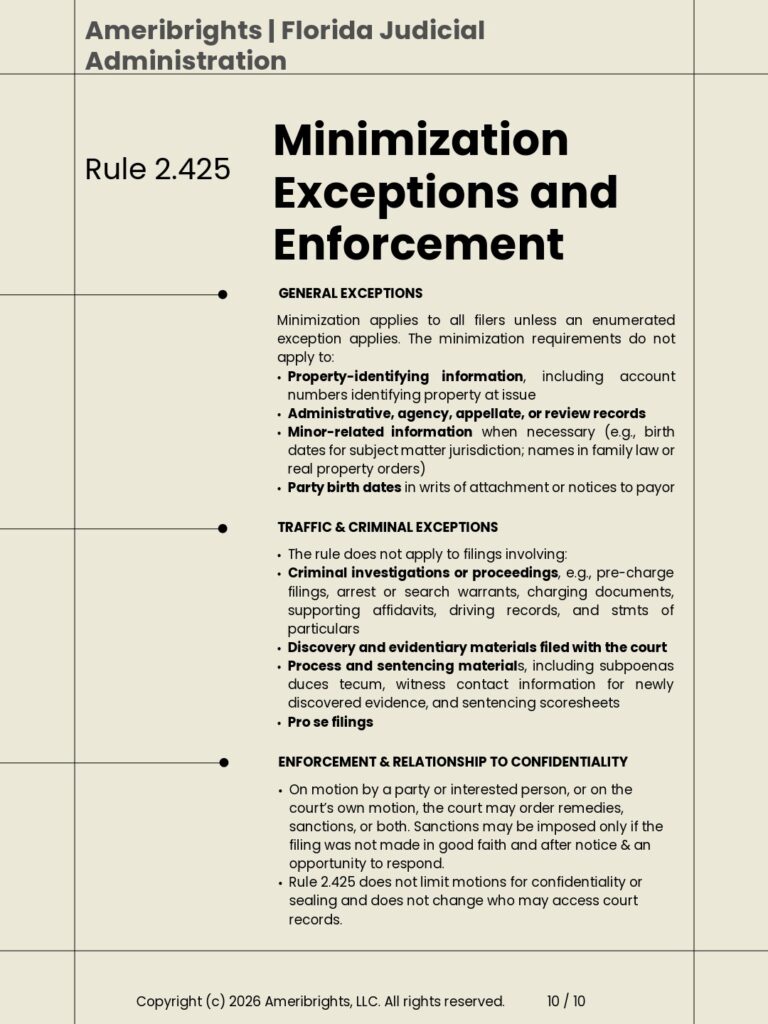
Minimization of Sensitive Information in Florida Court Filings
Minimization is one of the most misunderstood Judicial Administration rules because it sounds like a confidentiality rule. It isn’t.
Minimization governs how information is filed, not whether the information is confidential or publicly accessible. Florida uses this rule to place responsibility on the filer to limit unnecessary exposure of sensitive identifiers at the moment of filing.
In this section, we break down what information may never be filed in full, what may be filed only in part, and when truncation is required. We also explain when the minimization requirements do not apply and what authority the court has to address violations.
Florida tests this rule to see whether you recognize your affirmative obligation as a filer. The question usually isn’t whether the information is sensitive — it’s whether it was filed correctly.
Attorney Eligibility and Appearances in Florida Courts
This section explains who may practice law in Florida courts and the basic restrictions Florida places on attorneys, including limits on full-time court employees and how attorneys formally appear and withdraw in a case.
It also covers foreign attorneys (out-of-state attorneys) and the pro hac vice process. We break down when an out-of-state attorney may appear in a Florida case, what the verified motion must include, the requirement to associate Florida counsel, when separate permission is required in each court, and when repeated appearances can cross into an impermissible general practice.
Signature and Certification Requirements for Florida Pleadings
Florida treats signatures as certifications, not formalities.
When an attorney or party files or serves a document, Florida treats that act as a representation to the court. That representation covers compliance with filing rules, authorization of signatures, factual and legal support, and proper handling of confidential or sensitive information.
In this section, we explain what signing actually means in Florida practice, how electronic filing changes — and does not change — responsibility, and why accountability remains with the filer and signer. Florida tests whether you understand what filing represents, not whether you know where to place a signature block.
Disqualification of Florida Trial Judges
Florida tests judicial disqualification as a procedural safeguard, not as a determination of actual bias.
The rules focus on timing, sufficiency, and perspective. Florida asks whether a reasonable person in the moving party’s position would fear they cannot receive a fair trial, and it strictly limits what the judge may consider when ruling on an initial motion.
In the resource, we focus on who may move for disqualification, when the motion must be filed, what the judge may and may not do in response, and what happens after disqualification. Florida tests whether you understand the mechanics of the process — not whether the judge is actually biased.
How to Use the Judicial Administration Study Resource
A lot of people don’t have a clean outline for Judicial Administration at all. This resource can function as that outline.
We tried to cover the majority of what you realistically need to know for this subject — not every rule, but the areas that actually come up. If Judicial Administration is something you left for late in your study plan, or you don’t want to invest in another full study guide, this document is designed to get you oriented quickly.
Use it after reviewing Florida Civil Procedure or Florida Criminal Procedure, during short review sessions, or as a last-pass reference to help you recognize Judicial Administration questions without overthinking them.
Download the Judicial Administration Study Resource (PDF)
A consolidated reference covering the Judicial Administration rules Florida actually tests.
We respect your inbox. Unsubscribe anytime.
Final Thoughts
Judicial Administration isn’t an area where more volume or deeper analysis necessarily pays off.
The rules tend to focus on practical interactions with courts, records, and judges, and the questions that appear are usually direct. When that’s the case, the challenge isn’t complexity — it’s recognizing what’s being tested and responding efficiently under time pressure.
The goal isn’t to ignore these rules, and it isn’t to overstudy them. It’s to organize them well enough that, when a question appears, you can answer it confidently and move on.
That’s what this resource is meant to support.
If you decide you want a consolidated, exam-focused reference, our Florida & MBE Bundle now includes a Judicial Administration study guide.
Best Florida Bar Exam Study Resources
- Judicial Administration Tested on the FL Bar Exam?
- Spot Professional Responsibility on the FL Bar Exam (Free Handout)
- Florida Bar Exam Complete Guide
- Top Exclusions to Relevant Evidence Tested on the FL Bar Exam
- FL Bar Exam Essay Trends (2015-2025): High Tested Areas
- How to Retake the Florida Bar Exam: The Blueprint