Spot Professional Responsibility on the Florida Bar Exam (Free Handout)

In this article
In the days leading up to the bar exam, most students reach the same point: there is still a lot left to review, and not enough time to review everything.
Professional Responsibility is one of those subjects where a clear overview of the core rules can go a long way.
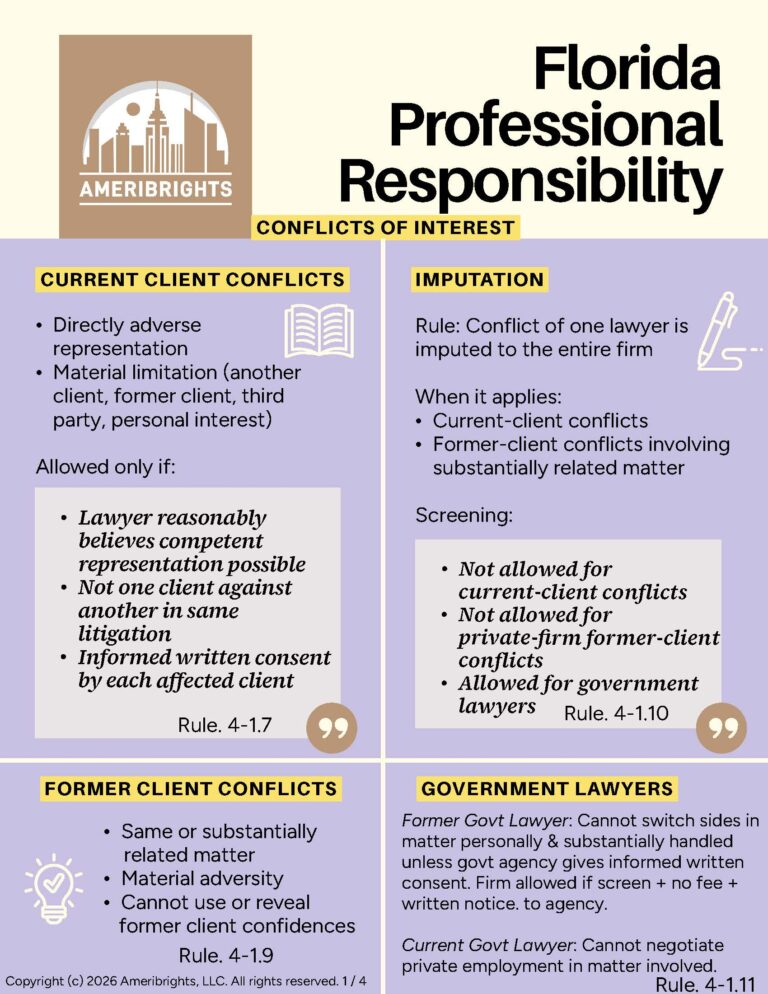
Before the February 2026 administration of the Florida Bar Exam, we shared a short Professional Responsibility handout with our email subscribers. It was meant as a last-minute review sheet for students who wanted to make sure they had covered the major ethics rules that tend to appear on the exam.
The goal was simple: highlight the rules and issue triggers examiners repeatedly test, organized in a way that could be reviewed quickly.
After the exam, several students who downloaded the guide reached out to say that the ethics issues they encountered were topics that appeared in the handout.
That was exactly the intention. And for that reason, the guide is now getting its own official place here on our site.
What made this handout a little different from many traditional outlines is the way it was built. Instead of starting with the FBBE study guide and working outward, I started with the essays themselves. In fact, I had already gone through every Professional Responsibility issue that appeared in past essays while preparing a previous blog article analyzing the sub-areas tested on the exam.
Working directly from the essays makes it much easier to see the patterns in how examiners actually test ethics issues — which rules appear most often, how they are embedded in fact patterns, and where they tend to show up within the questions.
Once those patterns are clear, the list of rules students truly need to recognize becomes much smaller than most people expect.
The “Sprinkles” on the Exam
Professional Responsibility is one of the more rule-driven and predictable areas on the Florida Bar Exam. It also tends to appear in a very particular way. It does not appear as a standalone essay topic. Instead, it is embedded within another subject.
For example, an essay might primarily test contracts, criminal law, property, or family law, but include an issue involving attorney’s fees, confidentiality, a conflict of interest, or duties to the court.
As you may be aware, we often refer to these issues as the “sprinkles” on the exam. And when an attorney appears in the fact pattern, that is usually the icing — a signal that ethics issues may be coming.
The main essay is the cake — the substantive subject being tested — but Professional Responsibility issues are frequently layered into the fact pattern.
Looking at past exams, Professional Responsibility appears in at least one essay question in nearly every administration, and sometimes more than once. When it appears, the fact pattern often triggers multiple ethics sub-issues within the same question. It is common to see two or three Professional Responsibility rules tested together, such as conflicts of interest combined with fee issues, or confidentiality questions tied to third-party payment.
If a student recognizes those issues and states the rule clearly, those points can add up quickly.
Professional Responsibility is not usually where students lose the exam — but it is often where they can quietly pick up additional points.
Why We Don’t Offer a Professional Responsibility Guide
One question we occasionally receive is whether we offer a full Florida Professional Responsibility Guide.
The short answer is: we don’t.
Professional Responsibility is an important subject, but it is also one of the more predictable areas on the exam.
There are only so many sub-areas that examiners tend to test, and the issues themselves are straightforward.
This is not typically the kind of question where examiners try to hide the issue the way they might on a tricky multiple-choice question. More often, the prompt will say something like “discuss any ethical concerns” or “discuss issues related to the attorney’s representation.”
When you see language like that, it is usually an invitation to identify the Professional Responsibility rules embedded in the fact pattern.
If you know the core areas that tend to appear and can state the rule in a sentence or two — and assuming you can apply the rule and write clearly — those points are very attainable.
In other words, those are the sprinkles.
So the goal here is not to memorize hundreds of pages of ethics rules. It is to recognize the core areas examiners repeatedly test and be ready to state the rule when you see it.
Save your brainpower for the subjects that require deeper analysis.
What the Handout Covers
The guide highlights several of the Professional Responsibility issues that appear most frequently in exam questions, including:
- Conflicts of interest
- Former client conflicts and imputation
- Fees and contingency fee requirements
- Third-party payment and independence of counsel
- Confidentiality and reporting duties
- Trust accounts and client funds
- Duties to the court and candor obligations
- Prosecutor responsibilities
- Competence and diligence
These are the areas where ethics issues most commonly arise when they are embedded within another essay.
If you recognize one of these issues in the fact pattern and can state the rule clearly, you are already well on your way to capturing those points.
That is the goal of the handout: to make sure you can spot the issue quickly and state the rule with confidence.
A Simple Strategy for Professional Responsibility
Because Professional Responsibility is so rule-driven, the strategy is usually straightforward.
When you see an ethics issue:
- Identify the rule being tested
- State the rule clearly
- Apply it to the facts in the question
Most of the time, the examiners are not trying to hide the issue. If the prompt asks you to discuss ethical concerns or issues related to an attorney’s representation, that is usually a clear signal that Professional Responsibility rules are in play.
In many cases, students can capture a meaningful portion of the available points simply by recognizing the ethical issue and articulating the relevant rule.
If you have not already reviewed it, our article How Is Florida Professional Responsibility Tested on the Bar Exam? breaks down the recurring ethics issues Florida repeatedly embeds within essay questions.
Florida’s ethics rules are codified in the Rules Regulating The Florida Bar, which you can review directly on the Florida Bar’s official website.
Download the Professional Responsibility Handout
For students preparing for a future administration of the exam, we are sharing the same handout here.
It is intended as a quick refresher of the Professional Responsibility rules and issue triggers that tend to appear repeatedly on the exam.
Sometimes a concise review of the core areas is exactly what you need in the final stretch before the exam.
You can download the Professional Responsibility handout below.
We respect your inbox. Unsubscribe anytime.