
Building Hidden Worlds with Concept Maps
In this article
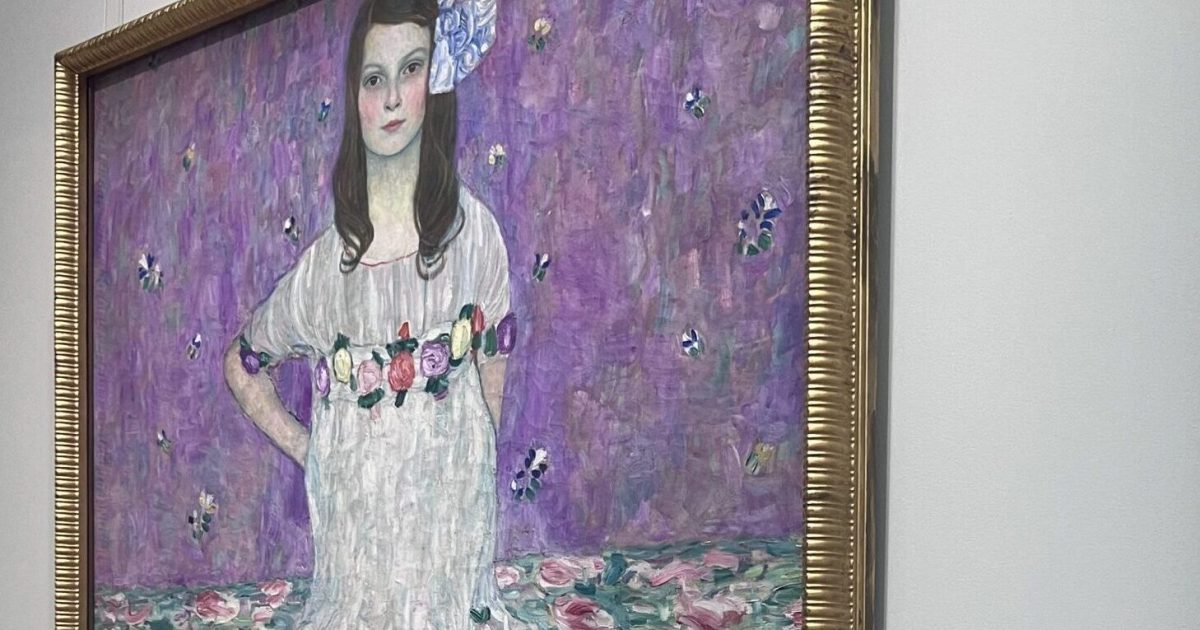
Last July, I was standing in front of Gustav Klimt’s portrait of Mäda Primavesi at the Metropolitan Museum of Art. I hadn’t expected to see much. Based on the washed-out pinks and dull purples I’d seen online, I figured it would look flat.
As I stood in front of it, however, I was surprised by how much I liked it. The real canvas holds a deep, bold purple with unexpected shadows and darker tones shifting underneath. Up close, the brushstrokes blend into a rich, physical depth.
First, I focused on the big picture—the main subject standing right in the center. Then, as I kept looking, the immediate visual pieces began to pull me in. I started tracking the rhythmic patterns and subtle echoes across the canvas, noticing details like the flowers around her waist quietly mimicking and forming relationships with the flowers beneath her feet.
Then I noticed her posture more clearly—feet planted wide, chin lifted, arms set in a way that anchored the entire composition. One hand rested on her hip, the other tucked slightly behind her, though neither hand was actually shown, as if she held something we did not know.
The painting revealed itself all at once, yes—but my understanding of it arose in layers.
Then I learned its history. In 1938, the painting was seized by the Nazis from its rightful owner, Jenny Pulitzer Steiner, in Vienna. It spent over a decade stolen and hidden before it was finally recovered and restituted to her family in 1951.
The painting wasn’t asking me to memorize it. With each pass, I discovered something new, and it became more unforgettable.
Seen through that history, her stance no longer felt merely elegant or confident. It felt defiant.
The painting didn’t change. My perception did.
This experience captures the way I think about concept maps. Traditional outlines compress the law into dense vertical text that rewards endurance. Concept maps are designed for learning that unfolds in layers, not in a single pass.
Seeing Structure
Before organizing a concept, I first have to recognize the structure that’s already there.
Orientation
Rather than immediately introducing every rule, exception, and nuance, I begin by helping learners see where they are within the broader structure of a subject.
For example, my Present Possessory Estates and Future Interests map introduces the major categories before branching into the individual estates and future interests. The immediate goal isn’t mastery. It’s orientation.
Before tackling dozens of individual rules, there’s a much simpler question to answer:
Where am I?
Once learners know where they are, every new rule has somewhere to belong.
Learning in Layers
Understanding doesn’t have to arrive all at once. Just as my perception of Klimt’s painting deepened as I noticed its patterns, posture, and history, legal understanding deepens as learners repeatedly return to an organized framework. The structure remains constant, but each revisit reveals new relationships, exceptions, and nuances that would have been much harder to appreciate in isolation.
Rather than overwhelming learners with every detail from the outset, I allow understanding to accumulate gradually. The organization provides a stable foundation while each return adds another layer of meaning. Each revisit doesn’t replace the previous one—it builds upon it.
Focus
Every page should have one organizing purpose.
I’ve seen countless concept maps online that attempt to fit an entire subject onto a single sheet of paper. While that approach may work well for some learners, I’ve found it has the opposite effect on me. Instead of helping me understand the law, it overwhelms me. The organization begins to disappear, relationships become harder to recognize, and what was intended to simplify the subject starts to feel more like navigating a maze.
That’s why I intentionally divide large subjects into multiple focused maps. Every page should answer a clear organizational question and have a distinct purpose. When I open a page, I want to immediately recognize where I am within the subject before I begin working through the details.
Organizational Strategies
At first glance, many concept maps look remarkably similar. Boxes. Lines. Arrows. It’s easy to assume the only real difference lies in the layout.
But that’s never been how I think about them.
As I built Ameribrights’ maps, I realized that different legal concepts demand different organizational strategies. The challenge isn’t arranging boxes on a page. It’s deciding how the law itself should be organized so it is easier to understand, navigate, and apply.
The organization should reflect the way the concept actually works, not the way it happens to appear in a textbook. My objective isn’t to make information look cleaner. It’s to reduce disorientation, reveal meaningful patterns, and help learners spend their mental energy understanding and applying the law rather than searching for it.
Every legal concept has to be represented somehow. An organizational strategy is simply the method I use to represent that concept visually. The same legal concept might be organized as a hierarchy, a sequence of questions, a comparison, a sequence of events, a branching pathway, or a recurring scenario. The strategy isn’t chosen for visual variety; it’s chosen because different concepts require different ways of thinking.
Before I design anything, I ask myself a series of questions.
- Is this concept best understood as a hierarchy?
- Is it fundamentally a comparison?
- Does it unfold as a sequence of questions?
- Are relationships the organizing principle?
- Does it function more like a decision tree?
- Or would an analytical framework better reflect how lawyers actually solve the problem?
Those answers shape every organizational decision that follows. Different structures don’t just change how information looks on the page. They change how learners encounter, navigate, and ultimately understand the concept itself.
Rather than relying on a single template, I choose the structure that best mirrors the reasoning process required to understand and apply the concept. Below are some of the organizational strategies I use most often. Many concept maps combine several of these approaches because legal concepts rarely fit neatly into a single pattern.
Questions
Not every concept is best understood as isolated pieces of information. Many topics are really a sequence of questions. Instead of organizing those subjects around individual concepts, I organize them around the sequence of questions a learner naturally asks while analyzing a problem.
For example, my Defeasible Fees map unfolds almost like a conversation:
- What is it?
- Who holds the future interest?
- What language creates it?
- What are common examples?
The organization mirrors the thought process itself. Learners move through the same sequence of questions they’re likely to ask when analyzing a bar exam fact pattern, allowing the law to unfold in the same order they’ll use it on exam day.
Comparisons
Some concepts are difficult not because they are individually complicated, but because they are easily confused with one another. When that’s the case, I intentionally use parallel structures so each concept is presented in the same order, answers the same questions, and occupies a similar position on the page.
For example, my Fee Simple Determinable and Fee Simple Subject to Condition Subsequent sections are organized almost identically. Both answer the same questions—What is it? Who holds the future interest? What language creates it?—in the exact same sequence.
By keeping everything else constant, the differences naturally stand out. Instead of searching for what changed, your attention is drawn directly to the precise point where the concepts diverge.
Sequence
Some concepts aren’t simply collections of rules—they unfold through a series of events. For those concepts, I organize the page to mirror the order in which the concept naturally develops rather than the order it happens to appear in a textbook.
For example, my Adverse Possession map doesn’t begin by listing every element in isolation. Instead, it follows the life of the claim. It begins with entry, moves through the running of the statutory period, and ends with the acquisition of title.
By organizing the concept as a sequence rather than a checklist, the learner experiences the legal analysis in the same order the events unfold. Instead of memorizing disconnected elements, they understand how each stage gives rise to the next.
Branches
Some concepts are not lists of categories at all. They are a series of forks in the road where each answer completely changes your next question. When that’s the case, I organize the page as a branching pathway rather than a traditional outline.
For example, the Landowner Liability map begins with the overarching question of how to approach land possessor liability under the modern or traditional approach before narrowing into the specific categories of entrants—like trespassers, licensees, or invitees.
Each answer determines the next step, allowing the learner to move through the concept the same way a lawyer analyzes the problem. This structure teaches learners how to navigate the analysis itself rather than memorize isolated pieces of information.
From Structure to Meaning
Although these organizational strategies differ, they all share the same purpose: to create a structure that makes the concept easier to navigate and understand. But for me, the organization is only the beginning. Once the framework is in place, I begin building something else onto it—something far more personal that has become central to how I learn and remember the law.
Building Hidden Worlds
For a long time, I didn’t know if I was cut out for law school. I was so bored reading traditional vertical outlines, and I completely zoned out in classes where I was expected to just sit there and type out every single word a professor said.
Then it finally clicked. The problem wasn’t my memory; it was meaning.
Traditional outlines present information in an arbitrary, vertical sequence. The law is logically organized, but required subjects rarely provide anything that naturally captures attention—and attention is the true gateway to memory.
I also realized that attention can’t simply be commanded. It has to be invited. When information feels disconnected from everything you already know, enjoy, or naturally notice, it’s difficult to force yourself to stay engaged. Looking back, I don’t think I lacked discipline. I think my mind was searching for something meaningful to hold onto, and traditional outlines gave it very little to work with.
Once I began working from stable concept maps instead, something unexpected happened. I wasn’t fighting to memorize anymore. I could breathe, I could create, and my mind began searching.
With the organization finally stable, I found myself noticing relationships I had completely missed before. Certain words echoed other words. Characters wandered naturally into certain concepts. Page locations started carrying weight. Images connected to vocabulary, and lyrics suddenly explained exceptions.
I even began embracing the scents of words, along with the quiet feelings certain numbers carried for me. Somehow, 3 became Florida and 6 became general law. At one point, I realized that even the movement of my fingers across a keyboard seemed to hold answers.
None of this was forced. It emerged. The organization gave my attention somewhere stable to linger long enough for those hidden relationships to reveal themselves.
Discovering A Foothold
How It Happens
The organized layout of the concept map gives me a stable visual foundation before I ever begin building a hidden ecosystem. Instead of fighting through a dense wall of text, I can simply look. My attention is finally free to wander, explore, and notice things that would normally go unseen.
My process almost always begins by searching for a foothold already hiding inside the law. Sometimes it’s the sound of a vocabulary word. Sometimes it’s the first letters of a series of elements. Sometimes it’s a visual pattern, an unusual phrase, or a word that reminds me of something completely unrelated.
Once I find that foothold, I ask a different question: What already exists in my life that naturally fits this?
I don’t try to invent random mnemonics. I look for people, stories, songs, places, or experiences that already occupy space in my mind.
For Property, my brain immediately goes to Monkey D. Luffy from One Piece because his world is already deeply familiar to me. I don’t have to memorize his universe—I already know it.
The word Easement naturally morphs into sea, and that’s the moment I know I’ve found my foothold. I don’t force anything after that. Once a meaningful doorway opens, the rest of the world usually begins building itself. At that point, the concept is no longer isolated. It now exists inside a world I already know intimately. I stop trying to memorize the law and start asking, “What belongs here?”
When Luffy eventually reaches shore, I look back at the map. The methods of creating an easement—Prescription, Implication, Necessity, and Express Grant—spell PINE. Since he’s standing on land for the first time, towering pine trees naturally appear on the beach. The acronym is no longer floating in isolation. It now occupies a physical place inside the landscape.
Your foothold will almost certainly look nothing like mine—and that is the point. The most useful associations are drawn from the worlds that already matter to you.
Why It Works
Instead of manufacturing a brand-new memory, I’m borrowing one that already exists.
The concept map provides the structure; my own experiences provide the meaning.
The map doesn’t create these associations—it creates the conditions that allow me to discover them.
Enriching the Landscape
How It Happens
The concept map cleanly splits the page, allowing me to build separate paths for each concept side by side. For Adverse Possession, the P in possession instantly reminds me of Pirates—who illegally take over things that aren’t theirs. My favorite pirate, Luffy, makes landfall to seize the land, but he’s exhausted and just wants a giant plate of nachos. The word NACHO perfectly activates the elements of Adverse Possession: Notorious, Actual, Continuous, Hostile, and Open.
Then, the narrative fluidly builds a separate bridge over to Easements. Because Luffy ate that entire massive plate of nachos, he feels terrible and now needs a doctor’s prescription for a stomachache. This links right back to Easements by Prescription. So, if I forgot the PINE I can still get myself to P by thinking of him eating NACHOs.
As he walks further inland to find a doctor, he encounters a friendly community cat. The PUR in appurtenant mirrors the cat loudly purring against his leg, making the vocabulary word instantly retrievable. Moments later, he runs into an incredibly unpleasant, “gross” person, providing an immediate emotional path to easements in gross.
Why It Works
By this point, the pathway is so enriched with life that it becomes extraordinarily difficult to forget. You haven’t simply memorized a legal rule—you’ve experienced a small story inside a stable environment.
A Prescriptive Easement is no longer just a vocabulary term. It’s simultaneously connected to the sea through the word ease, the pine trees lining the beach, and the prescription Luffy needs after eating an absurd amount of nachos. If one cue disappears, another immediately takes its place. Forget the pine trees, and the stomachache leads you back. Forget the prescription, and the beach or the sea brings you there instead. Each connection reinforces the others until retrieval becomes almost effortless.
Eventually, that process grows beyond individual doctrines. Sometimes it becomes an entire landscape.
I learned nearly all of Florida Trusts by weaving each new rule into a backpacking trip I once took through Turkey. Every new concept became another destination along a route I already knew by heart. I wasn’t forcing myself to memorize disconnected legal principles anymore. I was simply continuing a journey that already existed in my mind. Because the landscape was familiar, every new concept had somewhere meaningful to live.
Letting the World Evolve
How It Happens
One of the greatest strengths of concept maps is that they never need to change. Weeks later, I return to exactly the same page and notice something I completely missed before. I rarely create all of these connections at once on a first pass.
Instead, a different lyric fits; a new color choice connects to a different song; another character naturally belongs in that environment and steps onto Luffy’s beach to hold a newly discovered exception. The visible structure of the map remains completely unchanged, but the personal underlying web continues to organically grow underneath.
Why It Works
The structure stays constant while my understanding keeps growing. It transforms studying from a chore of forced endurance into an ongoing process of active discovery, giving your mind the breathing room it needs to build genuine depth.
Important Note
Don’t feel like you have to do this with every legal concept. I certainly don’t. Many rules become memorable simply because the organization makes the relationships obvious or because the concept already feels intuitive. Sometimes one small association is all I need. I tend to build these richer environments around the concepts that feel abstract, repeatedly slip away, or simply fail to hold my attention.
For me, this process serves two purposes at the same time. Yes, it strengthens memory, but just as importantly, it gives my attention a reason to stay. Once I’m curious about what new relationship I might discover next, studying stops feeling like something I have to force myself to do. I actually want to come back. And each return gives me another opportunity to deepen my understanding and strengthen the network I’ve already begun building.
Fail-Safe Memory
Eventually, I realized I wasn’t building mnemonics at all. I was building a fail-safe memory system.
Traditional mnemonics often depend on a single retrieval cue. Forget one letter of an acronym or lose track of a single association, and the entire chain can collapse under pressure.
My approach works differently.
Rather than attaching one fragile cue to an important legal concept, I deliberately surround it with multiple, independent pathways back to the same answer. A color. A scent. A page location. Taste. A visual image. A familiar character. A feeling. A numerical association. A song lyric. A play on words. A story. None of these associations has to work every time. They simply have to converge on the same legal rule.
That is what makes the system so dependable.
If one pathway disappears during an exam, another usually remains available. If I can’t remember the acronym, I may remember the image. If the image doesn’t come, I may remember the song lyric. If the lyric disappears, the page layout, character, or wordplay often leads me back to the very same rule.
This isn’t about creating one perfect mnemonic—it’s about making the memory difficult to lose.
Over time, these associations become so interconnected that the legal rule no longer hangs from a single thread. It becomes woven into a network. Every new connection strengthens the whole, making recall feel less like searching for one missing answer and more like approaching the same destination from multiple directions.
None of this would work nearly as well if the underlying structure kept changing. Because the concept map remains visually stable, every new cue attaches to the same location instead of competing with it.
The “Popstar” Blueprint
Here’s one example I built while studying for the Florida Bar Exam. My goal was never to memorize a flat rule. It was about creating vivid imagery that made me actually want to be present in the scene. Once I wanted to be there, each new observation naturally became another possible path back to the same legal concept.
Everything begins with the Fourth Amendment. The word Fourth immediately reminds me of four clementine peals. The first meaningful cue has now been planted, but if it fades, Drake’s Popstar music video brings me right back.
Justin Bieber wakes up in the Popstar video surrounded by bright orange bed sheets and the walls are painted orange behind him. The bright orange of the clementine suddenly comes to mind. I’ve also placed the clementine peals in the champagne he drinks on the couch. I can taste it even now. Now the legal concept isn’t attached to an isolated fact anymore. It has entered a living environment.
From the orange bedroom, my attention naturally shifts to another memorable visual in the video—the baby-blue Lamborghini Urus. That immediately brings back the lyric:
“Cops pullin’ up like I’m givin’ drugs out…”
“Cops” immediately signals police. The police bring me directly to search and seizure. Search and seizure reminds me that people have a reasonable expectation of privacy and the police need a valid warrant.
All I do is visualize Bieber PROWL’N in the Lamborghini. When you have a baby blue Lamborghini like that you be prowl’n instead of cruis’n. In plain English this means –
- Police
- Reasonable Expectation Of Privacy
- Warrant (valid) and
- UNless (exception)
A valid warrant is generally required… unless an exception applies. That word—unless—takes me back to the four clementine peals. Those peals become C PEALS, my retrieval cue for the warrant exceptions:
- Consent
- Plain View
- Exigent Circumstances
- Automobile
- Lawful Arrest
- Stop and Frisk
This is why this style of learning works so well. I’m not trying to force an abstract piece of text into my brain. The clementine, Bieber’s bedroom, fruity champagne, the Lamborghini, the lyrics, the police, search and seizure, reasonable expectations of privacy, warrants, and C PEALS all reinforce one another because they are part of the same cinematic space.
If one cue momentarily disappears, another usually brings me back to the same legal concept. The environment contains multiple paths home.
The scene doesn’t end here. Keep building upon it. Hide the drugs inside the Lamborghini. Imagine the phone calls referenced in the lyrics are being recorded. Let your curiosity keep asking, “What else can I place inside this world?” Every new connection makes the environment richer and creates another possible path home.
On Exam Day
As it turned out, I received this exact topic on my Florida Bar Exam.
The imagery didn’t slow me down at all. Quite the opposite. I finished the essay faster than I expected, and that actually made me nervous. I’ve always considered myself a decent writer, so I hadn’t practiced many Florida essays. Because the essay felt almost effortless, I assumed I must have missed something.
I think what surprised me most wasn’t that I remembered the law. It was that I never had to search for it. I didn’t waste a single precious minute fighting through mental static, trying to drag the rules out of hiding. They were simply there.
Looking back, it almost makes me laugh. While a lot of people in that room were likely battling anxiety and desperately searching for rules buried somewhere in memory, I was mentally strolling through a Justin Bieber music video with clementine peals, orange bed sheets, baby-blue Lamborghinis, and Drake lyrics floating around in my head. Strange as it sounds, those weren’t distractions—they were my retrieval cues. They weren’t pulling me away from the law; they were quietly leading me back to it.
That experience fundamentally changed the way I think about learning. My goal is no longer to memorize isolated legal rules. My goal is to build an environment so organized, meaningful, and interconnected that, under pressure, I don’t have to go searching for the law.
It’s already there.
Closing Thoughts
In many ways, this entire process isn’t very different from standing in front of Klimt’s painting at the museum. The physical canvas never changed from one minute to the next. What changed was my ability to slow down, return to it, and continue finding deeper layers of meaning within its framework.
The concept map provides the structure. My own experiences provide the meaning. Together, they create a landscape that memory naturally wants to revisit. Every return uncovers a layer that wasn’t visible before. The map never changes, but you do. Eventually, studying stops feeling like a forced exercise in memorization and starts feeling like coming back to a familiar place that is still revealing something new. Instead of dreading another review session, I found myself looking forward to it, driven by a genuine curiosity about what new relationships I might discover next.
Comprehension doesn’t deepen simply because we repeatedly encounter information. It deepens because, with each encounter, we perceive new relationships within it. A thoughtfully designed map gives learners the baseline structure, but the deep learning happens when they begin building their own invisible ecosystem on top of it. Retention becomes natural when the law becomes part of a world that already means something to you.
Over time, I realized something surprising. I wasn’t just building memory tricks; I was building environments.
Once those spaces became rich enough—infused with words, colors, music, movement, stories, characters, places, and emotions—they stopped functioning as isolated shortcuts. They became complete ecosystems where every element reinforced the other.
The law was no longer attached to a single fragile cue. It was woven into an entire world.
Putting It Into Practice
If you are ready to stop fighting your outlines and start building your own environments, you do not need to wait until you have mastered a subject to begin. You can start exactly where you are today.
Here is the process I use to transform legal concepts into a living environment I’ll actually want to return to.
1. Establish the Visible Canvas
If you’re creating your own concept maps, begin by organizing the legal concept into a visual framework. Ask yourself how the concept naturally wants to be represented. Is it a hierarchy? A comparison? A sequence of questions? A branching pathway? A timeline? Choose the organizational strategy that best mirrors the way the law actually works. If you’re using an existing concept map, spend time orienting yourself before worrying about memorization. Become familiar with the landscape before trying to memorize every detail.
2. Find Your First Foothold
Scan the map for a single visual pattern, unexpected acronym, phrase, or linguistic echo that naturally catches your eye. This is your doorway in. Let the word easement dissolve into the sea, or let a constitutional amendment activate a sensory cue like a bright orange clementine peel. Do not force these connections or manufacture complex, arbitrary mnemonics. The most resilient footholds are rarely consciously invented—they are simply noticed when you allow your attention to linger.
3. Borrow a Familiar World
Instead of building a brand-new memory from scratch, anchor your foothold to a world that already lives vividly in your mind. Reach for a story, film, neighborhood, song, or fictional world that you already know intimately without having to study it—whether that is the high-seas geography of One Piece or the neon, orange-tinted backdrop of a music video. You are looking for a pre-existing emotional and visual landscape that feels effortless to inhabit.
4. Build the Hidden World
Let the law step directly into this borrowed environment. Allow the rules to interact with the characters, the lyrics, the scenery, or the items within that space. Imagine a character physically standing on a beach surrounded by PINE trees to hold your easement creation rules, or visualize them PROWL’N through a cinematic scene to activate a Fourth Amendment analysis. The law is no longer a static line of vertical text; it is an active participant in a narrative.
5. Let It Grow
Do not try to build a flawless, fully realized world on your first pass. True depth accumulates in layers. Each time you revisit the visually stable map, let your mind wander through the landscape you’ve established. You will notice new relationships, subtle exceptions, and neighboring concepts that naturally want to pull up and park in the same space. The layout of the map remains unchanged, but the hidden world beneath it continues to grow richer with every return.
Note: The goal isn’t to recreate my associations. It’s to create your own. The map provides the landscape. You bring it to life. Your goal isn’t to remember my stories. It’s to discover your own. The more personal the environment becomes, the more likely you’ll want to return to it—and the easier the law becomes to understand, remember, and retrieve under pressure.
Want a Head Start?
You can absolutely build your own concept maps from scratch. That’s how I started. But you don’t have to spend valuable bar prep time figuring out the organization before you begin creating your own hidden worlds. If you’d rather start with a visual framework that’s already been thoughtfully organized, you can build on top of the Ameribrights MBE Concept Maps instead.
A quick note: Apparently I’ve gone my entire life thinking they’re called clementine peals. It wasn’t until I wrote this article that I realized they’re actually peels. By then, the mnemonic was already built around my mistake, so I decided to leave it alone rather than confuse anyone who might want to use the association.