
How to Prioritize MBE Areas Without Time (Part 3)

In this article
If you’ve made it this far, you’ve probably noticed a pattern.
Not all MBE subjects are tested the same way. Some subjects are heavily concentrated in a relatively small number of topics, while others distribute questions more evenly across multiple areas.
In Part 2, we saw that Evidence and Torts devote a significant percentage of questions to a relatively small number of heavily tested concepts. Criminal Law and Procedure follows a similar pattern, with Constitutional Protection of Accused Persons accounting for approximately one-half of all questions in that subject.
Real Property is different. Rather than concentrating questions in a single category, the NCBE distributes Real Property questions relatively evenly across five major areas. Contracts falls somewhere between these two approaches. While certain Contracts topics receive greater emphasis than others, success still requires a broad understanding of how contracts are formed, performed, breached, and enforced.
If you are running short on time, these differences in question distribution matter. Understanding where the NCBE concentrates questions can help you make more informed decisions about how to spend your remaining study time. In this final installment, we’ll take a closer look at Criminal Law and Procedure, Contracts, and Real Property and identify concepts that deserve extra attention.
Criminal Law and Procedure
What the NCBE Says
The NCBE’s official subject matter outline reveals something important: approximately one-half of all Criminal Law and Procedure questions come from a single category—Constitutional Protection of Accused Persons.
The remaining half of the subject is divided among Homicide, Other Crimes, Inchoate Crimes and Parties, and General Principles.
What the NCBE Means by Constitutional Protection of Accused Persons
This category includes arrest, search and seizure, confessions and the privilege against self-incrimination, lineups and other forms of identification, the right to counsel, fair trial rights, guilty pleas, double jeopardy, cruel and unusual punishment, burdens of proof and persuasion, and appeal and error.
Commonly tested issues include Fourth Amendment search and seizure issues, Fifth Amendment protections involving confessions and self-incrimination, and Sixth Amendment right-to-counsel protections.
What This Means for You
Your first priority should be Constitutional Protection of Accused Persons.
Because this category accounts for approximately one-half of all Criminal Law and Procedure questions, it deserves a disproportionate share of your attention.
If you’re deciding where to focus first, start with search and seizure, confessions, and the right to counsel. These issues appear repeatedly and often require you to work through a structured constitutional analysis.
The takeaway is simple: master the constitutional protections first, then build outward from there.
The High-Yield Intel
Search Incident to Arrest
Following a lawful arrest, police may search the arrestee and the area within the arrestee’s immediate control (often referred to as the arrestee’s “wingspan”) without a warrant. The search must be contemporaneous with the arrest and is justified by concerns for officer safety and the preservation of evidence.
When the arrest involves a recent occupant of a vehicle, the search may extend to the vehicle’s passenger compartment if the arrestee is unsecured and within reaching distance of the vehicle or if it is reasonable to believe the vehicle contains evidence of the offense of arrest. The search may include areas within the passenger compartment, such as the glove compartment, but does not automatically extend to the trunk.
Automobile Exception
Under the automobile exception, police may search a vehicle without a warrant if they have probable cause to believe it contains evidence of a crime or contraband.
The scope of the search extends to any area of the vehicle and any container that could reasonably contain the object of the search. However, the search must remain tied to the probable cause that justified it. For example, if police have probable cause to search for a stolen television, they generally may not open a small container that could not possibly conceal it.
Common MBE Trap: Before worrying about how far the police can search, first identify why the police are allowed to search. A lawful arrest triggers one set of rules. Probable cause to search a vehicle triggers another.
The Right To Counsel: Know When It Attaches
Many Criminal Procedure questions turn on timing.
The Sixth Amendment right to counsel attaches only after formal criminal proceedings begin. Once it attaches, it applies during critical stages of the prosecution, including arraignments, post-charge lineups, and guilty pleas.
Not every interaction between law enforcement and the accused qualifies as a critical stage. Procedures such as fingerprinting, blood draws, and photographic identifications generally are not considered critical stages for Sixth Amendment purposes.
On the MBE, start by asking whether formal criminal proceedings have begun and whether the event at issue qualifies as a critical stage of the prosecution.
Lineups
Lineup questions often test more than one constitutional doctrine. First, determine whether a Sixth Amendment right-to-counsel issue exists. Then consider whether the identification procedure was so suggestive that it violates Due Process.
When evaluating a suggestive lineup, focus on whether the identification remains reliable under the circumstances. Factors that may affect reliability include the witness’s opportunity to observe the suspect, the accuracy of prior descriptions, the witness’s level of certainty, and the amount of time that has passed since the event.
Even if a lineup procedure appears suggestive, the identification may still be admitted if the circumstances indicate that it remains sufficiently reliable.
Common MBE Traps
Right to a Jury Trial
Don’t assume that every criminal defendant has a constitutional right to a jury trial. The Sixth Amendment jury-trial right generally applies only when the charged offense carries a potential sentence of more than six months’ imprisonment.
Before analyzing jury composition, jury selection, or jury deliberations, determine whether the defendant is entitled to a jury trial in the first place.
Terry Stops and Frisks
Do not assume that a valid Terry stop automatically permits a frisk.
A Terry stop requires reasonable suspicion that criminal activity is afoot. A Terry frisk requires an additional reasonable suspicion that the individual is armed and dangerous. An officer may have sufficient grounds to stop someone for questioning but lack sufficient grounds to conduct a pat down.
When analyzing a Terry question, evaluate the stop and the frisk separately.
Double Jeopardy
Don’t assume that double jeopardy automatically applies simply because two charges arise from the same set of facts.
Instead, ask whether each offense requires proof of an element that the other does not. If each offense contains at least one unique element, the offenses may be considered distinct for double jeopardy purposes even though they arise from the same underlying conduct.
Focus on the elements of the offenses rather than the facts alone.
Self-Test
Police formally charge a suspect with armed robbery. Two days later, officers place the suspect in a lineup without notifying the suspect's attorney. The victim identifies the suspect. Does this raise a Sixth Amendment issue?
Yes. The Sixth Amendment right to counsel attaches once formal criminal proceedings begin. Because the lineup occurred after charges were filed, the suspect generally had a right to counsel during this critical stage. Had the lineup occurred before formal charges were filed, the Sixth Amendment generally would not have attached.
During a lawful traffic stop, an officer smells marijuana coming from a vehicle. Without obtaining a warrant, the officer searches the vehicle's trunk and discovers illegal drugs. Is the search likely constitutional?
Yes. Under the automobile exception, police may search a vehicle without a warrant if they have probable cause to believe it contains contraband or evidence of a crime. The search may extend to any area of the vehicle capable of concealing the object of the search, including the trunk and containers found inside the vehicle. Here, the odor of marijuana provided probable cause to search for drugs, which could reasonably be hidden in the trunk.
A suspect in custody states, "Maybe I should talk to a lawyer." Officers continue questioning the suspect, who eventually confesses. Is the confession automatically inadmissible?
Not necessarily. An ambiguous or equivocal reference to an attorney generally does not require officers to stop questioning. To invoke the Fifth Amendment right to counsel during a custodial interrogation, the suspect must make a clear and unambiguous request for an attorney.
Need More Criminal Law and Procedure Help?
Our Criminal Law and Procedure Guide and Maps expand on these heavily tested topics through plain-English Q&As, visual concept maps, and exam-focused explanations.
👉 Explore the Criminal Law and Procedure Guide and Maps
👉 View the Complete MBE Bundle
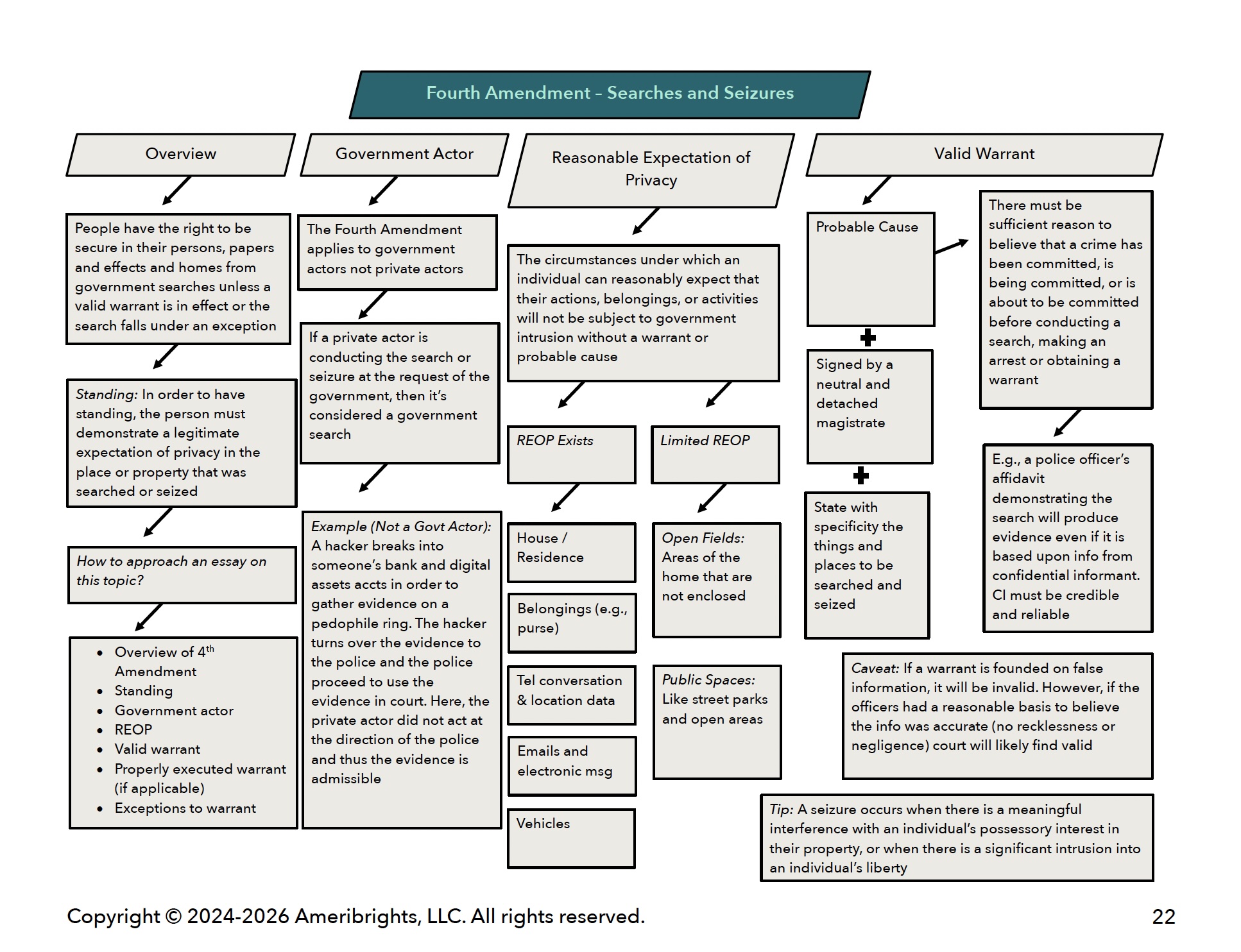
Sample Concept Map from Ameribrights Criminal Law and Procedure Maps
Sample Concept Map from Ameribrights Criminal Law and Procedure Maps
Contracts
What the NCBE Says
The NCBE’s subject matter outline reveals that approximately one-half of all Contracts questions come from just two categories: Formation of Contracts and Performance, Breach, and Discharge.
The remaining half of the subject is divided among Defenses to Enforceability, Contract Content and Meaning, Remedies, and Third-Party Rights.
The NCBE also notes that approximately one-fourth of all Contracts questions involve Articles 1 and 2 of the Uniform Commercial Code (UCC).
What the NCBE Means by Contract Formation and Performance, Breach, and Discharge
- Formation of Contracts focuses on whether a legally enforceable agreement was created in the first place. Questions frequently involve offer, acceptance, consideration, promissory estoppel, restitution, types of contracts, and contract modifications.
- Performance, Breach, and Discharge focuses on what happens after a contract has been formed. This category includes conditions, breach, anticipatory repudiation, warranties, risk of loss, impossibility, frustration of purpose, and the various ways contractual duties may be discharged.
Together, these categories test the questions that arise most often in contract disputes: Was a contract formed? Did the parties perform? If not, what are the consequences?
What This Means for You
Many Contracts questions follow a predictable sequence:
- Was a contract formed?
- If so, was it performed, breached, or discharged?
- What are the consequences?
Because Formation of Contracts and Performance, Breach, and Discharge account for approximately one-half of all Contracts questions, these categories deserve a disproportionate share of your attention.
As your understanding of that sequence improves, many Contracts questions become easier to analyze because the issues tend to build on one another.
The High-Yield Intel
If you’re looking for a few specific concepts that appear repeatedly on the MBE, start here.
Perfect Tender Rule
Under Article 2 of the UCC, a buyer generally may reject goods that fail to conform to the contract, even if the defect is minor. Unlike the common law substantial performance doctrine, the perfect tender rule does not require a material breach.
A buyer may accept the goods, reject some or all of the goods, or accept the goods and seek damages.
One important detail is that a seller is often given an opportunity to cure a nonconforming tender. If there is still time remaining for performance, or if the seller reasonably believed the goods would be acceptable, the seller may be permitted to correct the problem rather than immediately face rejection.
Anticipatory Repudiation and Adequate Assurances
A party commits anticipatory repudiation when they clearly and unequivocally indicate, through words or conduct, that they will not perform before performance is due. Once repudiation occurs, the non-breaching party may generally treat the contract as breached immediately rather than waiting for the performance date to arrive.
A common issue is distinguishing anticipatory repudiation from insecurity. Anticipatory repudiation requires a clear and unequivocal indication that performance will not occur. Insecurity is different. It arises when circumstances create a reasonable concern that the other party may not perform.
When reasonable grounds for insecurity exist, a party may suspend performance and demand adequate assurances. If adequate assurances are not provided within a reasonable time, the insecure party may treat the contract as repudiated.
Mirror Image Rule
One of the most important distinctions in Contracts is whether the transaction is governed by the common law or the Uniform Commercial Code (UCC).
Under the common law mirror image rule, an acceptance must exactly match the terms of the offer. Any addition, omission, or change to the offer generally operates as a rejection and a counteroffer rather than an acceptance.
The UCC takes a more flexible approach. A contract for the sale of goods may still be formed even when the acceptance contains additional or different terms. In some circumstances, those additional terms may become part of the contract, particularly when both parties are merchants.
When analyzing a Contracts question, first determine whether the transaction involves services, real estate, or another common law contract, or whether it involves the sale of goods governed by the UCC. That distinction often determines whether a modified acceptance creates a contract.
Common MBE Traps
Requirements and Output Contracts
One of the most important exceptions to the UCC quantity requirement involves requirements and output contracts.
A requirements contract allows a buyer to purchase the quantity of goods they require from a seller. An output contract allows a buyer to purchase the seller’s entire output. Although neither arrangement specifies an exact quantity, both are generally enforceable under the UCC.
The key limitation is good faith. A buyer in a requirements contract generally may increase or decrease its requirements, and a seller in an output contract may increase or decrease its output, so long as the change is made in good faith and is not unreasonably disproportionate to prior demands or output.
When you see a UCC contract that refers to a buyer’s requirements or a seller’s output rather than a specific quantity, don’t automatically assume the agreement is too vague to enforce.
Missing Price Terms
Not every contract requires the same level of specificity.
Under the common law, a real estate contract generally must identify both the property and the purchase price. If the price term is missing, the agreement is typically too indefinite to enforce.
The UCC takes a different approach. In a contract for the sale of goods, the absence of a price term does not automatically prevent contract formation. If the parties intended to form a contract, a court may supply a reasonable price based on market value, prior dealings, or other evidence.
When analyzing a contract formation question, pay close attention to whether the transaction involves real estate or the sale of goods. A missing price term may be fatal under the common law but not under the UCC.
When Consideration Is Missing
Many Contracts questions involve promises that appear enforceable at first glance but lack valid consideration.
Common examples include pre-existing legal duties, illusory promises, past consideration, moral obligations, and promises involving gifts. In each of these situations, the missing piece is a bargained-for exchange of legal value.
Pay particular attention to illusory promises. Language suggesting that a party “may” perform, rather than committing to perform, often indicates that no enforceable promise has been made.
When evaluating consideration, ask whether each party has actually exchanged something of legal value or whether one party is merely promising to do something they were already obligated to do.
Self-Test
A seller contracts to deliver 1,000 blue widgets to a buyer. The seller delivers 1,000 widgets, but 20 of them are green. May the buyer reject the shipment?
Yes. Under the UCC’s Perfect Tender Rule, a buyer generally may reject goods if the seller fails to make a perfect tender, even when the defect is relatively minor.
On June 1, a contractor agrees to build a garage for a homeowner. On June 15, before performance is due, the contractor informs the homeowner, "I will not be building your garage." Must the homeowner wait until the performance date to sue?
No. This is anticipatory repudiation. Because the contractor clearly and unequivocally indicated that performance would not occur, the homeowner may generally treat the contract as breached immediately.
A homeowner offers to pay a painter $5,000 to paint a house. The painter responds, "Does that $5,000 price include the cost of materials?" Has the painter rejected the offer?
No. This response is a request for information rather than a counteroffer. Questions seeking clarification generally do not terminate the original offer.
Need Help with Contracts?
Our Contracts Guide and Maps expand on these heavily tested concepts through plain-English Q&As, visual concept maps, and exam-focused explanations.
👉 Explore the Contracts Guide and Maps
👉 View the Complete MBE Bundle
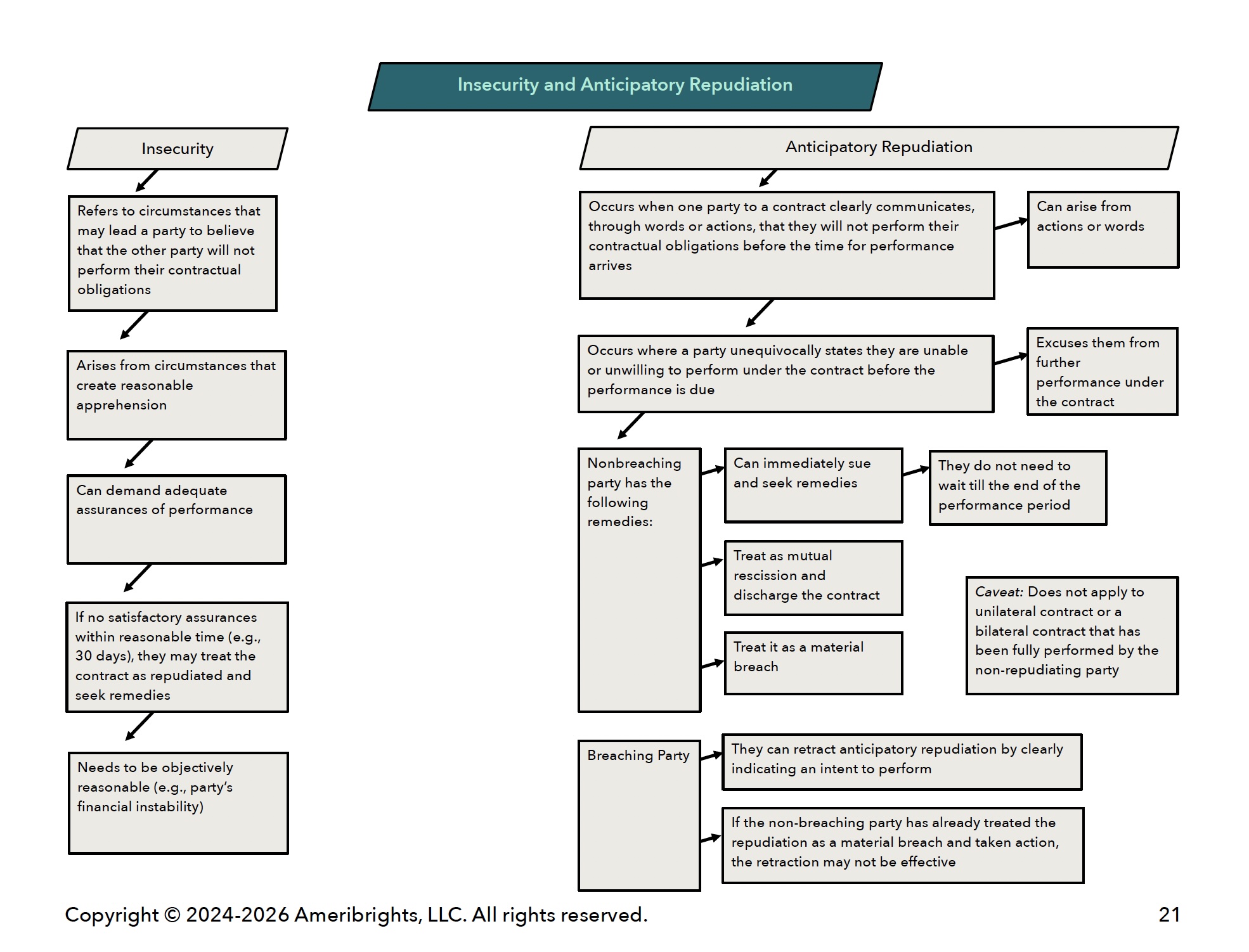
Sample Concept Map from Ameribrights Contracts Maps
Sample Concept Map from Ameribrights Contracts Maps
Real Property
What the NCBE Says
Unlike several other MBE subjects, Real Property does not have a single dominant category. The NCBE’s subject matter outline indicates that approximately one-fifth of Real Property questions come from each of the five major categories: Ownership of Real Property, Rights in Real Property, Real Estate Contracts, Mortgages and Security Devices, and Titles.
As a result, Real Property is one of the few MBE subjects where broad coverage remains especially important.
What the NCBE Means by These Categories
Because no single category dominates Real Property, it is important to understand the major categories being tested.
- Ownership of Real Property focuses on present estates, future interests, cotenancy, landlord-tenant law, and the Rule Against Perpetuities.
- Rights in Real Property includes easements, covenants, fixtures, and zoning.
- Real Estate Contracts examines issues such as marketable title, risk of loss, and the Statute of Frauds.
- Mortgages and Security Devices focuses on mortgage relationships, foreclosure, and redemption rights.
- Titles covers adverse possession, deeds, recording acts, and title assurance systems.
Although these categories appear very different on the surface, many Real Property questions ultimately test competing rights in land and the rules that determine which interest prevails.
What This Means for You
TL;DR: Real Property becomes much easier when you recognize the patterns being tested. Consider whether the category’s topics are primarily timeline-based, relationship-based, or priority disputes. If you’re overwhelmed, start with the categories that align most naturally with the way you already solve problems, then build outward from there.
Real Property is one of the few MBE subjects where broad coverage matters more than prioritization. Because the NCBE distributes questions relatively evenly across the major categories, there is no single topic that can carry your score.
Instead, think about the categories based on the type of reasoning they require.
Some areas, such as Real Estate Contracts and many Mortgage questions, are heavily driven by timelines. You are following a transaction from one event to the next and determining the legal consequences along the way.
Other areas, such as Easements, Covenants, and Future Interests, are relationship-based. These questions require you to identify who has rights in the property and how those rights affect one another.
Still others, such as Recording Acts and certain Mortgage questions, function as priority disputes. Multiple parties claim rights in the same property, and your job is to determine whose interest prevails.
These are not rigid categories, and some topics overlap. However, recognizing the dominant pattern in a question can make Real Property much easier to analyze.
As those patterns become familiar, many seemingly unrelated rules become easier to organize and apply.
The High-Yield Intel
Easements by Necessity: Necessity Does Not Mean Convenience
An easement by necessity arises when a parcel is landlocked and has no other reasonable means of access. Questions frequently test the difference between true necessity and mere convenience.
The fact that an easement would provide a shorter route, easier access, or a more practical way to reach a public road is generally not enough. The key question is whether the property has any other reasonable means of access.
When evaluating an easement by necessity, focus on whether access is actually necessary rather than simply more convenient.
Tacking and Tolling
Adverse possession questions often turn on whether the statutory period has been satisfied.
Tacking allows successive adverse possessors to combine their periods of possession to satisfy the statutory period. To tack periods together, there must generally be privity between the possessors.
Tolling works in the opposite direction. The running of the statutory period may be suspended when the true owner is under a legal disability, such as minority or mental incapacity.
When an adverse possession question involves multiple possessors or an owner with a legal disability, pay close attention to whether the statutory clock is running, paused, or being combined with another period of possession.
Recording Acts and Bona Fide Purchasers
Many Real Property questions involve multiple parties claiming rights to the same property. When that happens, first identify the type of recording act: notice, race-notice, or race.
In a notice jurisdiction, a later purchaser generally prevails if they purchased for value and without notice of the earlier interest. In a race-notice jurisdiction, the later purchaser generally must purchase for value, lack notice of the earlier interest, and record first. In a race jurisdiction, the party who records first generally prevails, even if that party had notice of the earlier interest.
Do not assume that recording alone always determines the outcome. Ask whether the statute protects a bona fide purchaser, whether the later party gave value, and whether the party had actual, constructive, or inquiry notice of the competing claim.
Common MBE Traps
Easements by Prescription: Similar to Adverse Possession, But Not the Same
An easement by prescription generally requires open, notorious, actual, continuous, and hostile use for the statutory period. However, unlike adverse possession, exclusivity is generally not required.
Because easements by prescription closely resemble adverse possession, many people incorrectly assume that the same elements apply to both doctrines. The key distinction is that a prescriptive easement creates a right to use the land rather than ownership of it.
Deed Types: Not All Deeds Provide the Same Protection
Many Real Property questions test the level of title protection a particular deed provides.
A general warranty deed provides the greatest protection because the grantor warrants against title defects arising both during and before the grantor’s ownership. A special warranty deed provides more limited protection, covering only title defects arising during the grantor’s period of ownership. A quitclaim deed provides the least protection because it conveys whatever interest the grantor has, if any, without any covenants or warranties.
When evaluating a deed question, focus on what promises the grantor is making about title. The answer often turns on the type of deed being used rather than whether the property was successfully conveyed.
Implied Warranty of Habitability
Many people spend time memorizing the definition of the implied warranty of habitability and very little time studying the remedies that flow from it.
Remember that the implied warranty of habitability applies to residential leases, not commercial leases.
If a landlord breaches the implied warranty of habitability, the tenant’s options may include rent withholding, repair and deduct, terminating the lease, or remaining in possession and suing for damages.
When studying landlord-tenant law, make sure you understand not only what the warranty requires, but also the remedies that become available when it is breached.
Self-Test
A seller conveys Blackacre by quitclaim deed. Several years later, the buyer discovers that a third party holds superior title to the property. May the buyer sue the seller for breach of deed covenants?
Generally no. A quitclaim deed conveys whatever interest the grantor has, if any, and contains no covenants or warranties regarding title.
A tenant rents a residential apartment. During the winter, the building's heating system fails, leaving the apartment without heat for several weeks. The landlord refuses to make repairs despite receiving notice. If the tenant chooses to stay in the apartment, may they still sue the landlord for damages?
Yes. A tenant is not required to move out to seek relief under the implied warranty of habitability. If a landlord breaches the warranty, and the tenant has given proper notice and a reasonable opportunity to repair, the tenant may remain in possession of the premises and sue for damages.
A landowner openly, notoriously, continuously, actually, and hostilely uses a path across a neighbor's property for the statutory period. Several other people occasionally use the same path. Is a prescriptive easement automatically defeated because the use was not exclusive?
No. A prescriptive easement generally requires open, notorious, actual, continuous, and hostile use for the statutory period. Unlike adverse possession, exclusivity is generally not required because a prescriptive easement creates a right to use the land rather than ownership of it.
Need Help with Real Property?
Our Real Property Guide and Maps expand on these heavily tested topics through plain-English Q&As, visual concept maps, and exam-focused explanations.
👉 Explore the Real Property Guide and Maps
👉 View the Complete MBE Bundle
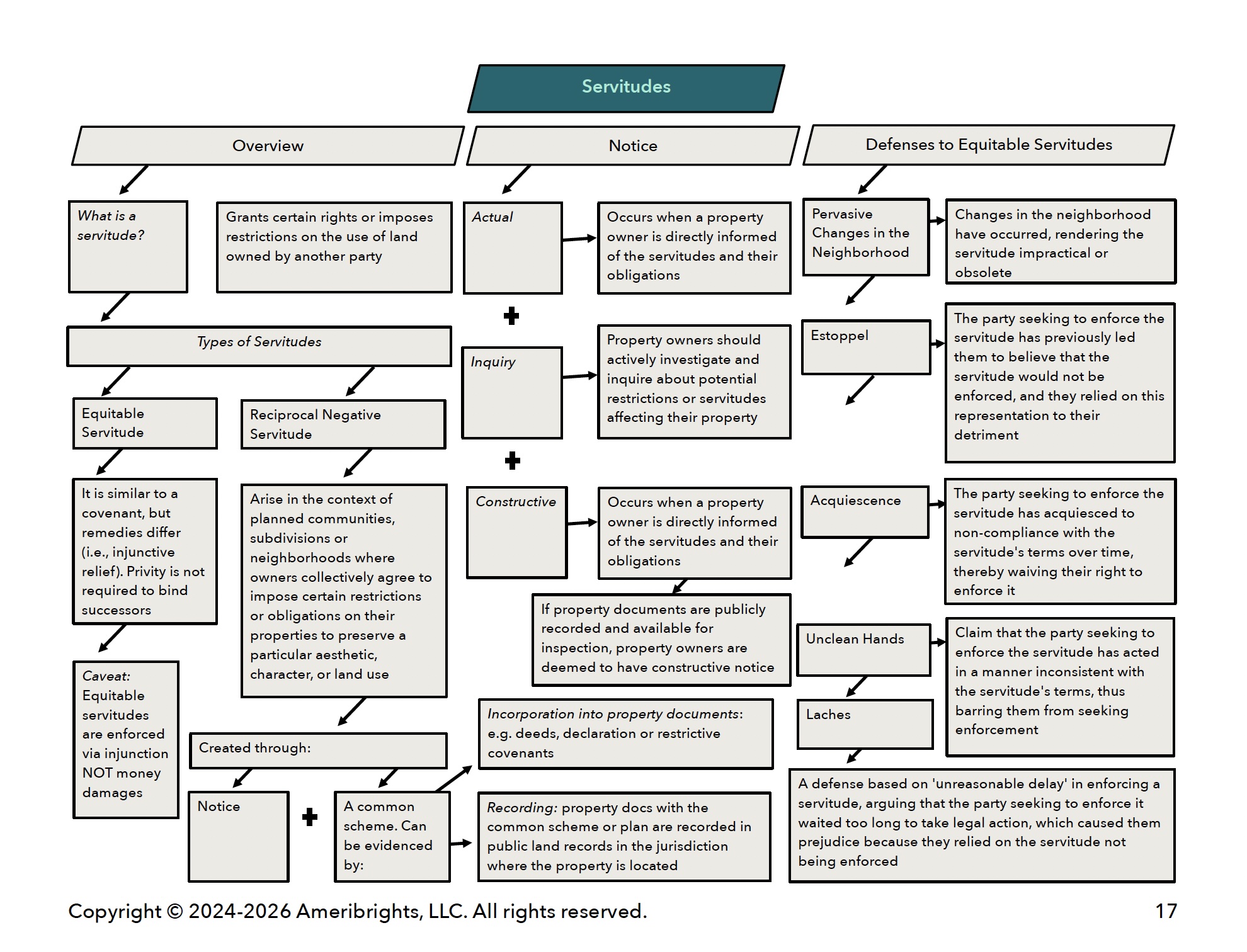
Sample Concept Map from Ameribrights Real Property Maps
Sample Concept Map from Ameribrights Real Property Maps
Closing Thoughts
This series was never about cutting corners. It’s about making informed decisions when time is limited.
The NCBE’s subject matter outline cannot tell you exactly what will appear on your exam, but it can help you understand where the examiners concentrate their attention. When study time is scarce, that information can help you allocate your efforts more strategically.
As always, use these percentages as a guide rather than a substitute for comprehensive preparation. The goal is not to ignore entire subjects or categories. The goal is to understand where additional study time is most likely to pay off and to make informed decisions when you cannot cover everything as thoroughly as you would like.
If there is a topic, subject, study obstacle, or mindset issue you would like us to cover in a future article, send us a message. Many of our articles begin with conversations like these, and we genuinely enjoy hearing what is working—and what is not.