
How to Prioritize MBE Areas Without Time (Part 1)

In this article
At some point during bar prep, you start to feel like you’re racing against the clock.
Maybe you’ve spent weeks working through a commercial bar prep course and still feel like there is too much left to learn. Maybe you started later than you planned and are trying to catch up. Or maybe you’re self-studying and realizing that you cannot realistically master every topic before exam day.
If that’s where you are right now, this article is for you.
I’m not writing this for the person who has unlimited time and can work through every assignment in a commercial course without missing a beat.
I’m writing this for the person who needs to triage.
The person balancing work, family obligations, financial stress, health issues, or simply the reality that there are only so many hours left before the exam.
At some point, you realize that you are not fighting a knowledge problem.
You are fighting a time problem.
There is simply too much material, too many assignments, and too few days remaining before the exam to treat every topic equally. When time becomes the limiting factor, prioritization becomes a skill.
At some point, every examinee faces the same question:
“If I can’t study everything, what should I study first?”
Fortunately, the National Conference of Bar Examiners (NCBE) provides some guidance. The NCBE publishes an outline showing how MBE questions are distributed across major subject areas. While no blueprint can predict exactly what will appear on your exam, it can help you make smarter decisions about where to invest your remaining study time.
In this first installment, we’re going to use the NCBE’s published weighting information to identify where a disproportionate number of points live in two heavily tested subjects: Civil Procedure and Constitutional Law.
Civil Procedure
What the NCBE Says
The NCBE’s published subject matter outline states that approximately two-thirds of Civil Procedure questions are drawn from three major categories: Jurisdiction and Venue, Pretrial Procedures, and Motions.
What the NCBE Means by These Categories
To understand why these categories matter, you first need to understand what the NCBE places inside these three heavily tested categories:
- Jurisdiction and Venue: This category encompasses subject-matter jurisdiction, personal jurisdiction, notice and service of process, venue, transfer of venue, forum non conveniens, removal, remand, and Erie doctrine issues.
- Pretrial Procedures: This category includes pleadings, amendments to pleadings, joinder of claims and parties, compulsory and permissive counterclaims, crossclaims, impleader, intervention, class actions, injunctions and temporary restraining orders (TROs), discovery, sanctions, Rule 11 issues, pretrial conferences and orders, adjudication without trial, and summary judgment.
- Motions: This category covers motions to dismiss, motions challenging jurisdiction or venue, motions for summary judgment, motions for judgment as a matter of law (JMOL), renewed JMOLs, motions for a new trial, and other procedural motions that arise before, during, and after trial.
What This Means for You
If you’re running out of time, do not treat every Civil Procedure topic equally.
Your first priority should be mastering the areas that generate the largest share of MBE questions: Jurisdiction & Venue, Pretrial Procedures, and Motions. These categories account for roughly two-thirds of all Civil Procedure questions, making them some of the highest-value topics in the subject.
Before spending hours on Jury Trials and Verdicts, make sure you can confidently answer questions involving subject matter jurisdiction, personal jurisdiction, discovery, joinder, summary judgment, and post-trial motions.
The High-Yield Intel
The NCBE categories above are broad. If you’re short on time, here are a few high-value concepts within those categories that deserve special attention.
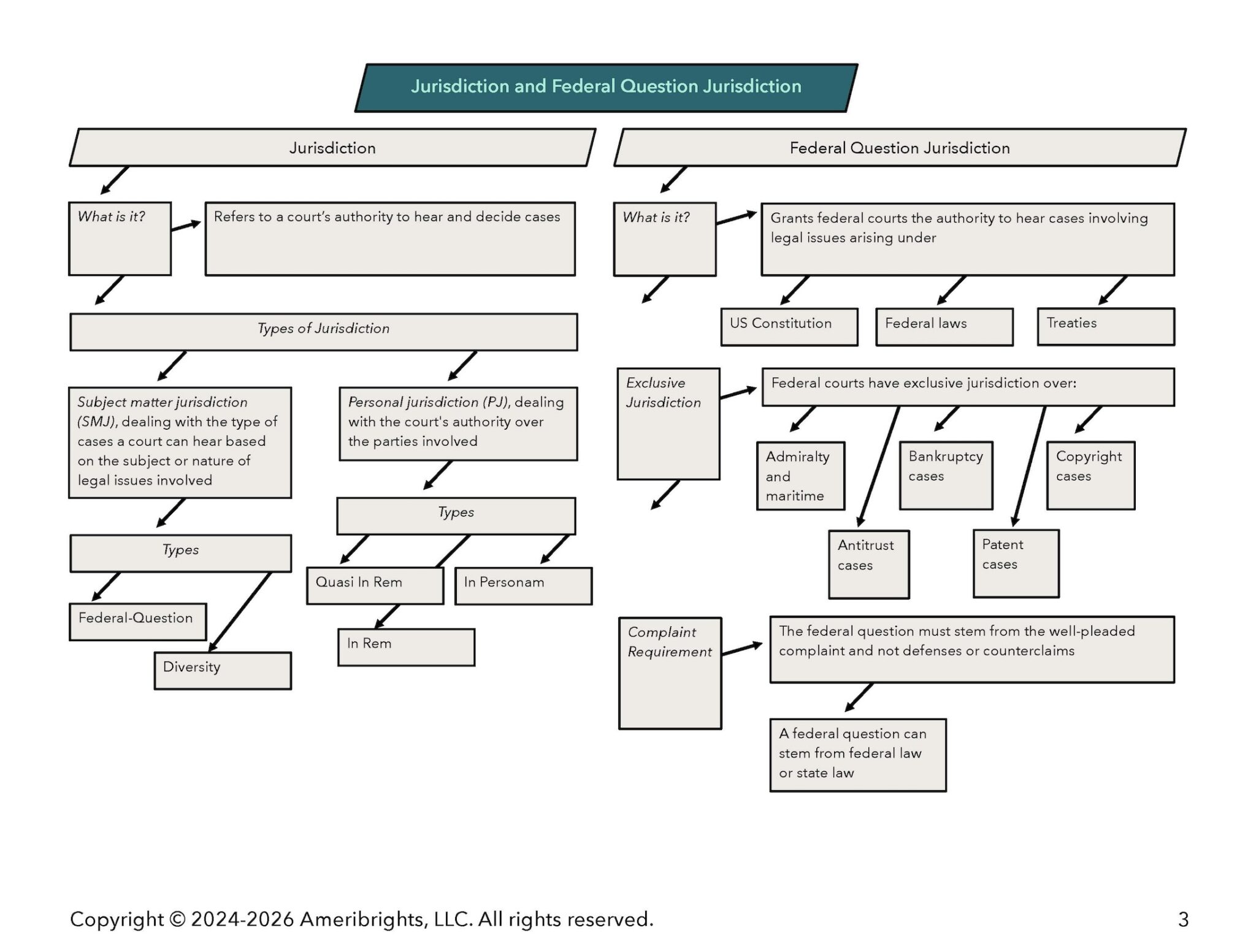
Subject Matter Jurisdiction
Subject-matter jurisdiction determines whether a federal court has the authority to hear a particular type of case.
- Federal Question Jurisdiction: Federal courts can hear cases arising under the U.S. Constitution, federal laws, or treaties. Unlike diversity jurisdiction, there is no amount-in-controversy requirement.
- Diversity Jurisdiction: Diversity jurisdiction requires complete diversity between plaintiffs and defendants and an amount in controversy exceeding $75,000. Both requirements are evaluated at the time the lawsuit is filed.
- The Well-Pleaded Complaint Rule: The federal issue must appear in the plaintiff’s complaint. A defendant cannot create federal-question jurisdiction simply by raising a federal defense or counterclaim.
Notice and Service of Process
You cannot legally force a defendant to defend a lawsuit unless they receive constitutionally adequate notice and proper service of process.
- The Five Things to Remember: Every service question boils down to five issues: the summons, the complaint, timing, location, and who performed the service.
- Summons and Complaint: Proper service generally requires both a valid summons and a copy of the complaint. The summons must notify the defendant that a lawsuit has been filed and that a response is required.
- Timing Matters: A defendant generally must be served within 90 days after the complaint is filed. Failure to serve within that window may result in dismissal.
- Location Matters: Service is typically made within the forum state, although certain federal rules permit service beyond state lines in limited circumstances.
- Who Can Serve: Service may generally be made by any nonparty who is at least 18 years old. Plaintiffs cannot personally serve the summons themselves.
- Waiver of Service: A defendant may agree to waive formal service. If they do, they receive additional time to respond—60 days instead of the usual 21 days.
Venue, Transfer, and Forum Non Conveniens
Venue is not about whether a court has power to hear a case. Venue simply determines which judicial district is the proper location for the lawsuit.
- Where Venue Is Proper: Venue is generally appropriate where a defendant resides, where a substantial part of the events giving rise to the claim occurred, or where the property at issue is located. If no district satisfies those rules, venue is proper in any district where a defendant is subject to personal jurisdiction.
- Transfer of Venue: If the original venue is proper, a federal court may transfer the case to another proper venue for the convenience of the parties and witnesses and in the interest of justice. If the original venue is improper, the court may dismiss the action or transfer it to a proper venue.
- Forum Non Conveniens: When a substantially more convenient forum exists outside the federal court system—such as a foreign country—the court cannot transfer the case. Instead, it may dismiss the action under the doctrine of forum non conveniens, provided the plaintiff has an adequate alternative forum available.
Common MBE Traps
The examiners love to test your memory on the exact timing of diversity jurisdiction. They will describe a scenario where a plaintiff properly claims $80,000 in damages on day one, but by the end of the trial, the jury only awards $10,000. Many examinees see the final award fall below the $75,000 threshold and mistakenly conclude that diversity jurisdiction no longer exists. Don’t fall for it. Diversity jurisdiction is evaluated at the time of filing. If it existed on day one, it generally remains intact.
Another classic trap involves the Well-Pleaded Complaint Rule. The examiners will present a lawsuit based entirely on state law and then tell you that the defendant intends to raise a federal defense or federal counterclaim. Many examinees immediately assume federal-question jurisdiction exists. It doesn’t. The federal issue must appear in the plaintiff’s complaint. A federal defense or counterclaim is not enough to create federal-question jurisdiction.
Self-Test
A plaintiff files a diversity action in federal court seeking $100,000 in damages. After trial, the jury awards only $15,000. Does the federal court lose subject-matter jurisdiction?
No. Diversity jurisdiction is determined at the time the lawsuit is filed. Once diversity jurisdiction is properly established, a later reduction in the amount recovered does not destroy the court’s jurisdiction.
A plaintiff files a state-law negligence claim in state court. The defendant plans to raise a defense based on a federal statute. Does federal-question jurisdiction exist?
No. Federal-question jurisdiction depends on the plaintiff’s complaint—not the defendant’s response. Under the Well-Pleaded Complaint Rule, the federal issue must appear on the face of the complaint itself. A federal defense or counterclaim cannot create federal-question jurisdiction where none existed when the lawsuit was filed.
A defendant receives a request to waive formal service of process and agrees. How much time does the defendant generally have to file an answer?
60 days. A defendant who agrees to waive formal service is rewarded with additional time to respond. Many examinees automatically default to the standard 21-day response period, but a valid waiver changes the timeline. Once a defendant agrees to waive service, they generally have 60 days from the date the waiver request was sent to file an answer.
Need More Civil Procedure Practice?
Our Civil Procedure Guide expands on these heavily tested topics through plain-English Q&As, visual concept maps, and exam-focused explanations.
👉 Explore the Civil Procedure Guide and Maps
👉 View the Complete MBE Bundle
Sample Concept Map from Ameribrights Civil Procedure Maps (see below)
Sample Concept Map from Ameribrights Civil Procedure
Constitutional Law
What the NCBE Says
The NCBE’s subject matter outline reveals a massive statistical shortcut for Constitutional Law: approximately half of all Con Law questions on the MBE are drawn from a single category: Individual Rights. The remaining half is split evenly among Judicial Review, Separation of Powers, and The Relation of Nation and States in a Federal System.
What the NCBE Means by Individual Rights
The NCBE’s Individual Rights category is broad, which helps explain why it accounts for approximately half of all Constitutional Law questions on the MBE.
- State Action: This requirement determines whether constitutional protections apply at all. The examiners test whether a seemingly private actor is sufficiently connected to the government through public functions, entanglement, or significant state involvement.
- Due Process and Equal Protection: This core area examines how the government affects individual rights. It includes procedural due process, substantive due process, equal protection, fundamental rights, and the various levels of constitutional scrutiny.
- First Amendment Freedoms: This heavily tested area covers freedom of religion, freedom of speech, freedom of the press, and freedom of association. The NCBE frequently tests content-based restrictions, content-neutral regulations, commercial speech, expressive conduct, prior restraints, vagueness, and overbreadth.
- Other Constitutional Protections: This category includes the Takings Clause, privileges and immunities protections, the Contracts Clause, unconstitutional conditions, bills of attainder, and ex post facto laws.
What This Means for You
Individual Rights should be one of your highest Constitutional Law priorities. Because it accounts for approximately half of all Constitutional Law questions on the MBE, you cannot afford to skim it.
Before spending significant time on executive powers, congressional authority, or federalism doctrines, make sure you have a solid command of equal protection, due process, and First Amendment freedoms. Those topics generate a substantial portion of the Constitutional Law questions you are likely to encounter on exam day.
The High-Yield Intel
The Individual Rights category encompasses numerous constitutional protections. If you’re prioritizing your remaining study time, these are three areas that consistently generate a significant number of Constitutional Law questions on the MBE.
Equal Protection
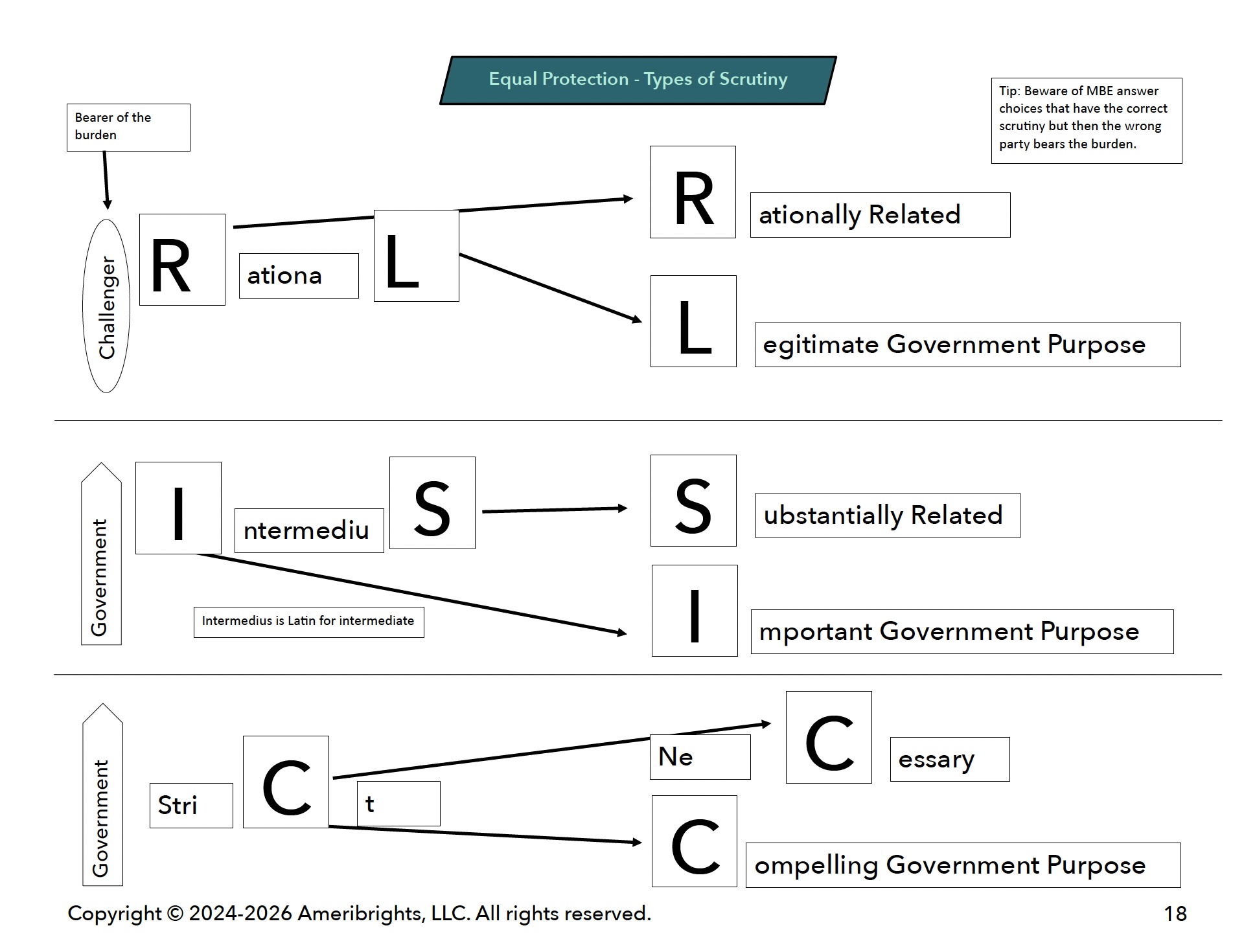
When the government treats groups of people differently, courts apply one of three levels of scrutiny.
- Strict Scrutiny: Applies to classifications based on race and national origin. The government must prove the law is narrowly tailored to achieve a compelling government interest.
- Intermediate Scrutiny: Applies to classifications based on gender and legitimacy. The government must prove the law is substantially related to an important government interest.
- Rational Basis Review: Applies to most other classifications. The law will generally be upheld if it is rationally related to a legitimate government interest.
First Amendment Free Speech
The government’s ability to regulate speech often depends on the type of speech being regulated. When you see a First Amendment question, start by determining which of the following categories applies.
- Content-Based Restrictions: These laws regulate speech because of the message being expressed. Content-based restrictions are generally subject to strict scrutiny, meaning the government must prove the restriction is narrowly tailored to achieve a compelling government interest.
- Content-Neutral Restrictions: When speech occurs in a traditional public forum, such as a street, sidewalk, or public park, the government may impose content-neutral time, place, and manner restrictions if they are narrowly tailored to serve a significant government interest and leave open adequate alternative channels of communication.
- Unprotected Speech: Certain categories of speech receive little or no First Amendment protection. Common examples include incitement, fighting words, true threats, and obscenity.
Takings
The Fifth Amendment permits the government to take private property for public use through eminent domain.
- Requirements: (1) public use (rationally related to a legitimate government purpose) and (2) just compensation.
- Actual Possession: Government physically occupies or seizes property.
- Economic Taking: Regulation deprives owner of property rights or interferes with reasonable investment-backed expectations.
- Just Compensation: Generally measured by the fair market value of the property at the time of the taking. Temporary interference may warrant compensation if it causes a compensable loss. If no compensable loss is shown, compensation may not be required.
Common MBE Traps
The examiners love to test your understanding of Equal Protection by giving you answer choices that identify the correct level of scrutiny but assign the burden to the wrong party. For example, a question may correctly identify age as a rational basis classification and then incorrectly state that the government must prove the law is rational. Don’t fall for it. Under rational basis review, the challenger bears the burden of proving that the law is not rationally related to a legitimate government interest.
Another classic trap involves content-neutral speech restrictions. The examiners will present a law regulating speech in a public park, on a sidewalk, or during a parade and tempt you to jump straight to strict scrutiny. Before you do, ask whether the government is targeting the message itself or merely regulating the time, place, and manner of the speech. If the regulation is content-neutral, strict scrutiny generally does not apply.
Self-Test
A private advocacy organization exists to promote a particular political message. The organization refuses to admit an applicant because it believes the applicant's views would undermine that message. The applicant sues, arguing the exclusion violates the First Amendment. Is the organization likely permitted to exclude the applicant?
Yes. A group may exclude someone if inclusion would significantly burden the group’s ability to express its message.
A public high school permits secular student groups to meet on school property after hours but blocks a student-led Bible study group from doing the same to avoid appearing to endorse religion. Is the school's decision constitutional?
No. Once a public school opens a limited public forum, it generally may not exclude a student group based solely on the religious viewpoint of its speech. Permitting the Bible study group to meet on equal terms with other student groups does not violate the Establishment Clause.
A citizen actively joins a radical political group knowing the leadership intends to unlawfully destroy government property. However, the citizen only intends to participate in the group's peaceful rallies. Can the citizen be constitutionally convicted based solely on group membership?
No. Mere membership is not enough. The government must prove the individual actively affiliated with the group, knew of its illegal objectives, and specifically intended to further those illegal objectives.
Need More Constitutional Law Practice?
Our Constitutional Law Guide expands on these heavily tested topics through plain-English Q&As, visual concept maps, and exam-focused explanations.
👉 Explore the Constitutional Law Guide
👉 View the Complete MBE Bundle
Sample Concept Map from Ameribrights Constitutional Law Maps (see below)
Sample Concept Map from Ameribrights Constitutional Law
What’s Coming in Part 2?
Civil Procedure and Constitutional Law are only two of the seven MBE subjects.
In Part 2, we’ll use the NCBE’s published weighting data to identify where a disproportionate number of points live in Evidence and Torts, including the specific topics that deserve the greatest share of your remaining study time.
We’ll also cover common MBE traps, self-test questions, and practical ways to prioritize these subjects as exam day approaches.
Until then, focus on mastering the high-yield concepts discussed above before spending valuable study time on lower-priority topics.
You do not need to know everything before exam day. You need to know where the points are.
Looking for additional resources to help with the Multistate Bar Examination (MBE)?
- Free 188 Ameribrights Q&A (MBE)
- How to Study for the MBE in One Month
- The Hidden Mechanics of Bar Exam Success: Mind
- How to Prioritize MBE Areas Without Time (Part 3)
- Fix a Low MBE Score (Self-Assessment Tool)
- MBE Subject Performance Tracker
- MBE Score Analyzer for Bar Exam Retakers
- CORE System Handout
- NCBE Subject Matter Outline