
How to Prioritize MBE Areas Without Time (Part 2)
In this article
In Part 1 of this series, we examined Civil Procedure and Constitutional Law and identified the areas that the NCBE tests most heavily.
Now, we turn our attention to Evidence and Torts.
The goal remains the same. We are not trying to identify every rule that could possibly appear on the exam. Instead, we are looking at the NCBE’s published subject matter outline to understand where questions are concentrated and how that information can help guide your study decisions when you are short on time.
As you’ll see, the NCBE provides some surprisingly useful clues. In Evidence, approximately 83% of questions come from just three categories. In Torts, a single category—Negligence—accounts for approximately one-half of the entire subject.
Let’s take a closer look at what that means.
Evidence
What the NCBE Says
The NCBE’s official subject matter outline reveals something important: the 25 scored Evidence questions are heavily concentrated in just three categories.
According to the NCBE, approximately one-third of all Evidence questions come from Relevancy and Reasons for Excluding Relevant Evidence. Another one-quarter come from Presentation of Evidence, and one-quarter come from Hearsay and Circumstances of Its Admissibility.
Combined, these three categories account for approximately 83% of all Evidence questions. The remaining questions are drawn from Privileges and Other Policy Exclusions and Writings, Recordings, and Photographs.
What the NCBE Means by These Categories
To prioritize effectively, aim to understand what the NCBE places inside these three heavily tested categories.
- Relevancy and Reasons for Excluding Relevant Evidence: This category includes areas such as relevance, Rule 403 balancing, authentication, character evidence, habit and routine practice, prior bad acts, expert testimony, and real or demonstrative evidence.
- Hearsay and Circumstances of Its Admissibility: This category covers areas such as the definition of hearsay, statements by party-opponents, prior witness statements, multiple hearsay, common hearsay exceptions, business and public records, former testimony, statements against interest, present sense impressions, and Confrontation Clause issues.
- Presentation of Evidence: This category focuses on the mechanics of trial evidence, including witness competency, personal knowledge, refreshing recollection, judicial notice, presumptions, examination of witnesses, and impeachment and rehabilitation of witnesses.
What This Means for You
If you’re running out of time, do not treat every Evidence topic equally.
Your first priority should be Relevancy and Reasons for Excluding Relevant Evidence. This category alone accounts for approximately one-third of all Evidence questions, making it the largest category in the subject.
The next two categories—Presentation of Evidence and Hearsay and Circumstances of Its Admissibility—each account for approximately one-quarter of all Evidence questions.
If you’re deciding where to focus next, consider which category is more likely to click for you. Some people find hearsay easier because it follows a structured framework: Is it hearsay? Is it non-hearsay? Does an exemption or exception apply? Others find witness impeachment, personal knowledge, and trial procedures more intuitive because they mirror the mechanics of a courtroom.
The takeaway is simple: use the NCBE’s weighting information as a guide, not a mandate. While heavily tested categories often deserve additional attention, your remaining study time may be better spent in the areas where you can make meaningful progress most quickly.
The High-Yield Intel
Relevance and Rule 403
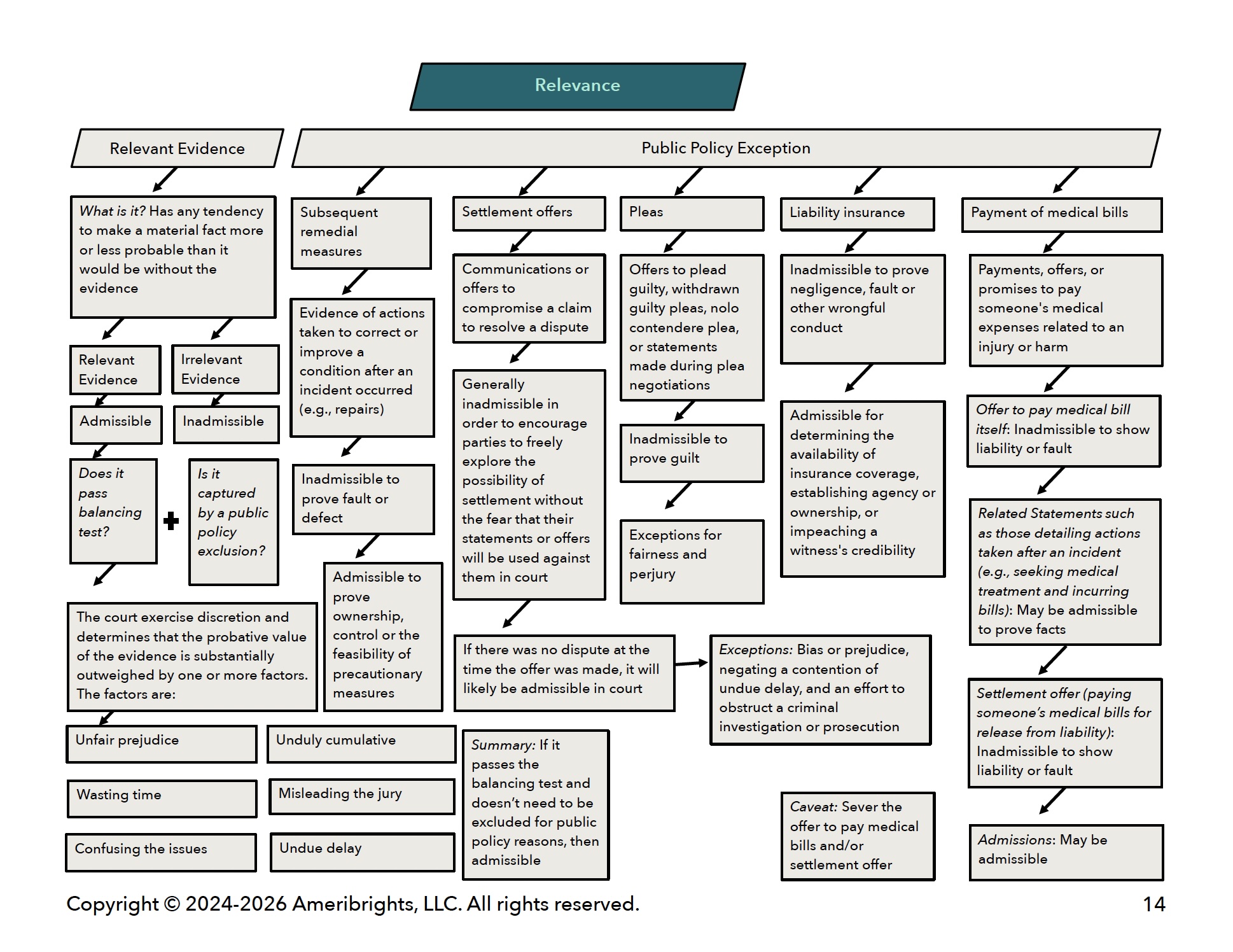
Evidence is relevant if it has any tendency to make a fact of consequence more or less probable than it would be without the evidence.
But relevant evidence is not automatically admissible. After determining relevance, ask whether the evidence should still be excluded.
First, relevant evidence may be excluded under Rule 403 if its probative value is substantially outweighed by dangers such as unfair prejudice, confusing the issues, misleading the jury, undue delay, wasting time, or needlessly cumulative evidence.
Second, certain relevant evidence may be excluded for public policy reasons, including subsequent remedial measures, settlement offers, plea negotiations, liability insurance, and offers to pay medical expenses. These rules often test whether evidence is being offered for a prohibited purpose or for some other permissible reason.
On the MBE, do not stop at “is it relevant?”
The better question is: is it relevant, and is there a reason to exclude it anyway?
Settlement Offers and Liability Insurance
This often appears on the MBE as a fact pattern involving a dispute that requires some sort of compromise between the parties. Evidence of settlement offers and statements made during settlement negotiations is generally inadmissible. The rule exists to encourage parties to explore settlement without fear that their statements will later be used against them in court.
One important detail is whether a dispute actually existed at the time the statement was made. If there was no dispute regarding liability or the amount of the claim, the statement may be admissible.
What about liability insurance? It depends on why the evidence is being offered. Liability insurance is generally inadmissible to prove negligence, fault, or other wrongful conduct. However, it may be admissible for another purpose, such as proving ownership, control, agency, or witness bias.
On the MBE, don’t stop once you determine that evidence is relevant. Ask whether a public policy exclusion applies and whether the evidence is being offered for a different reason than the one the rule prohibits.
Hearsay
Before diving into all the various hearsay types, train yourself to run every single hearsay question through the exact same four-step sequence:
- Is there a statement? (An oral assertion, written assertion, or nonverbal conduct intended as an assertion).
- Was it made outside the current courtroom? (An out-of-court statement).
- Is it being offered to prove the truth of what it asserts? (If it’s offered for another purpose—such as its effect on the listener, the speaker’s knowledge, or the declarant’s state of mind—the hearsay analysis stops immediately because it is not hearsay).
- Does an exemption or exception apply?
Some MBE questions are solved simply by catching a statement that isn’t even being offered for its truth, saving you from wasting time hunting for an exception.
Common MBE Traps
Prior witness statements can create problems for examinees who remember only part of the rule. Pay special attention to prior inconsistent statements made under oath because they may be admissible both for impeachment and for their truth.
Habit evidence is another area where examinees sometimes confuse two different concepts. The key question is whether the conduct reflects a specific, repeated response to a particular situation. Evidence that someone always follows the same routine may qualify as habit evidence, while evidence that a person is generally careful, reckless, honest, or dishonest is usually character evidence.
Statements made by a party-opponent are also easy to confuse with statements against interest. When a party’s own statement is offered against that party, it does not need to have been against the speaker’s interest when it was made, and it does not require the speaker to be unavailable. Many examinees begin analyzing the statement-against-interest exception when the opposing party’s statement exemption applies.
Pro Tip: For additional Evidence practice, review NCBE Sample MBE questions 2 and 19. Pay attention to the testing patterns and the specific evidentiary rule being tested before checking the answer explanation.
Self-Test
A woman tells her friend, "My neighbor threatened me yesterday." In a later lawsuit, the statement is offered to show why the woman moved out of her apartment the next day. The neighbor objects on hearsay grounds. Is the statement hearsay?
No. The statement is not being offered to prove that the neighbor actually made the threat. Instead, it is offered to show its effect on the listener—explaining why the woman moved. Because the statement is not being offered for its truth, it is not hearsay.
In a negligence lawsuit arising from a car accident, the plaintiff wants to introduce a text message sent by the defendant stating, "I ran the red light and caused the crash." The defendant objects, arguing that the statement is hearsay. Admissible?
Yes. This is an opposing party’s statement. A party’s own statement, when offered against that party, is not excluded by the hearsay rule. It does not matter whether the statement was against the speaker’s interest when it was made, and it does not require the speaker to be unavailable.
While watching a car speed through an intersection, a pedestrian immediately called her friend and said, "That blue car just ran the red light." At trial, the pedestrian is unavailable to testify. The plaintiff seeks to introduce the statement. Admissible?
Yes. The statement may qualify as a present sense impression because it describes an event while the declarant was perceiving it or immediately afterward. The declarant does not need to be unavailable for this exception to apply.
Need Help with Evidence?
Our Evidence Guide and Maps expand on these heavily tested topics through plain-English Q&As, visual concept maps, and exam-focused explanations.
👉 Explore the Evidence Guide and Maps
👉 View the Complete MBE Bundle
Sample Concept Map from Ameribrights Evidence Maps
Sample Concept Map from Ameribrights Evidence Maps
Torts
What the NCBE Says
The NCBE’s official subject matter outline reveals that approximately one-half of all Torts questions are drawn from a single category: Negligence.
The remaining Torts questions are divided among several other categories, including Intentional Torts, Strict Liability and Products Liability, and Other Torts.
If you’re running out of time, negligence deserves a disproportionate share of your attention. No other Torts category comes close to generating as many MBE questions.
What the NCBE Means by Negligence
Because negligence accounts for approximately one-half of all Torts questions, it’s worth understanding exactly what the NCBE places inside this category.
Negligence encompasses nearly every major issue that appears in a standard negligence claim. According to the NCBE outline, this category includes duty, breach, standards of care, negligence per se, res ipsa loquitur, actual cause, proximate cause, superseding causes, premises liability, negligent infliction of emotional distress, pure economic loss, vicarious liability, independent contractors, comparative negligence, contributory negligence, and assumption of risk.
What This Means for You
Do not treat every Torts topic equally.
Your first priority should be Negligence.
Within negligence, however, not every sub-topic deserves the same amount of attention. Consider focusing first on the concepts that form the foundation of most negligence questions, including duty, the standard of care, causation, and common defenses such as comparative negligence and assumption of risk. These concepts appear repeatedly throughout the negligence category and often determine whether a plaintiff can recover.
One advantage of prioritizing negligence is that the concepts build on one another. Duty leads to breach. Breach leads to causation. Causation leads to damages and defenses. As your understanding of the framework improves, many negligence questions become easier to analyze.
The High-Yield Intel
If you’re looking for a few specific concepts that appear repeatedly on the MBE, start here.
Liability for the Acts of Others (Employees and Agents)
- Respondeat Superior: An employer is vicariously liable for torts committed by an employee acting within the scope of employment.
- Frolic vs. Detour: An employer remains liable for minor, foreseeable deviations from an employee’s assigned work route (a detour). However, liability ends when the employee abandons their duties entirely for personal reasons (a frolic).
- Intentional Torts: Employers are generally not liable for an employee’s intentional torts. Exceptions apply when force is an inherent part of the job or when the employee acts to further the employer’s business.
- Independent Contractors: A hiring party is generally not liable for the torts of an independent contractor. Important exceptions include inherently dangerous activities and nondelegable duties, such as a commercial business owner’s duty to keep its premises safe for invitees.
Apportionment of Responsibility Among Multiple Tortfeasors
- Joint and Several Liability: When multiple tortfeasors cause an indivisible injury, each tortfeasor may be held liable for the plaintiff’s entire damage award.
- Contribution: A tortfeasor who pays more than their fair share of a joint judgment may seek contribution from the other tortfeasors based on their relative degrees of fault.
- Indemnity: Indemnity shifts the entire loss from one party to another. It commonly arises when a completely passive party is held liable solely because of a legal relationship, such as an employer held vicariously liable for an employee’s negligence.
The Standard of Care for Children
- The General Rule: Children are not held to the ordinary adult reasonable person standard. Instead, they are expected to exercise the degree of care that would be exercised by a child of similar age, intelligence, education, and experience.
- The Adult Activity Exception: When a child engages in an inherently dangerous activity normally reserved for adults—such as driving a car, operating a motorboat, or flying an airplane—the child loses this special protection and is held to the objective adult standard of care.
Common MBE Traps
Here are a few distinctions that routinely appear in Torts questions.
Some examinees spot a breach of duty and immediately conclude that the defendant is liable. Not so fast. Negligence requires both actual cause and proximate cause. A defendant may breach a duty of care and still avoid liability if the plaintiff’s injury results from an unforeseeable superseding event.
Another common trap involves negligence per se. Some examinees assume that any statutory violation automatically establishes liability. Not necessarily. Before applying negligence per se, ask whether the statute was designed to protect against the type of harm that occurred and whether the plaintiff falls within the class of persons the statute was intended to protect. Even when negligence per se applies, the plaintiff must still prove causation and damages.
Finally, always pay attention to the theory of liability being tested. A fact pattern may emphasize that a defendant exercised reasonable care and had no way of discovering a defect. Those facts are powerful in a negligence question but largely irrelevant in a strict products liability question. Before analyzing the facts, identify the claim the plaintiff is actually bringing.
Pro Tip: For additional Torts practice, review NCBE Sample MBE questions 4, 15, and 17. Pay attention to how the NCBE tests duty, strict liability, and privacy torts before checking the answer explanations.
Self-Test
A delivery driver deviates two blocks from their assigned delivery route to pick up some dry cleaning. While turning into the dry cleaner's parking lot, the driver negligently strikes a pedestrian. Is the employer vicariously liable?
Yes. This is a classic detour—a minor, foreseeable deviation from the employee’s work duties. Because the driver was on a detour rather than a frolic (a total abandonment of employment duties), the employer remains vicariously liable under respondeat superior.
A 12-year-old child is operating a boat on a crowded lake. The child fails to look behind them while reversing and strikes a swimmer. At trial, the child asks the judge to instruct the jury to evaluate their conduct based on what a reasonable 12-year-old would do. Should the judge grant the request?
No. Operating a boat is an inherently dangerous adult activity. Because the child engaged in an adult activity, the adult activity exception applies, and the child is held to the same objective reasonable person standard as an adult.
A consumer is injured when a brand-new toaster explodes due to a latent manufacturing defect. The consumer sues the retail store where they purchased it under a strict products liability theory. The retail store proves it exercised reasonable care and could not have discovered the defect. Is the store liable?
Yes. In a strict products liability action, the retailer’s exercise of reasonable care is irrelevant. Commercial sellers in the chain of distribution may be held strictly liable for defective products, regardless of whether they exercised reasonable care.
Need Help with Torts?
Our Torts Guide and Maps expand on these heavily tested topics through plain-English Q&As, visual concept maps, and exam-focused explanations.
👉 Explore the Torts Guide and Maps
👉 View the Complete MBE Bundle
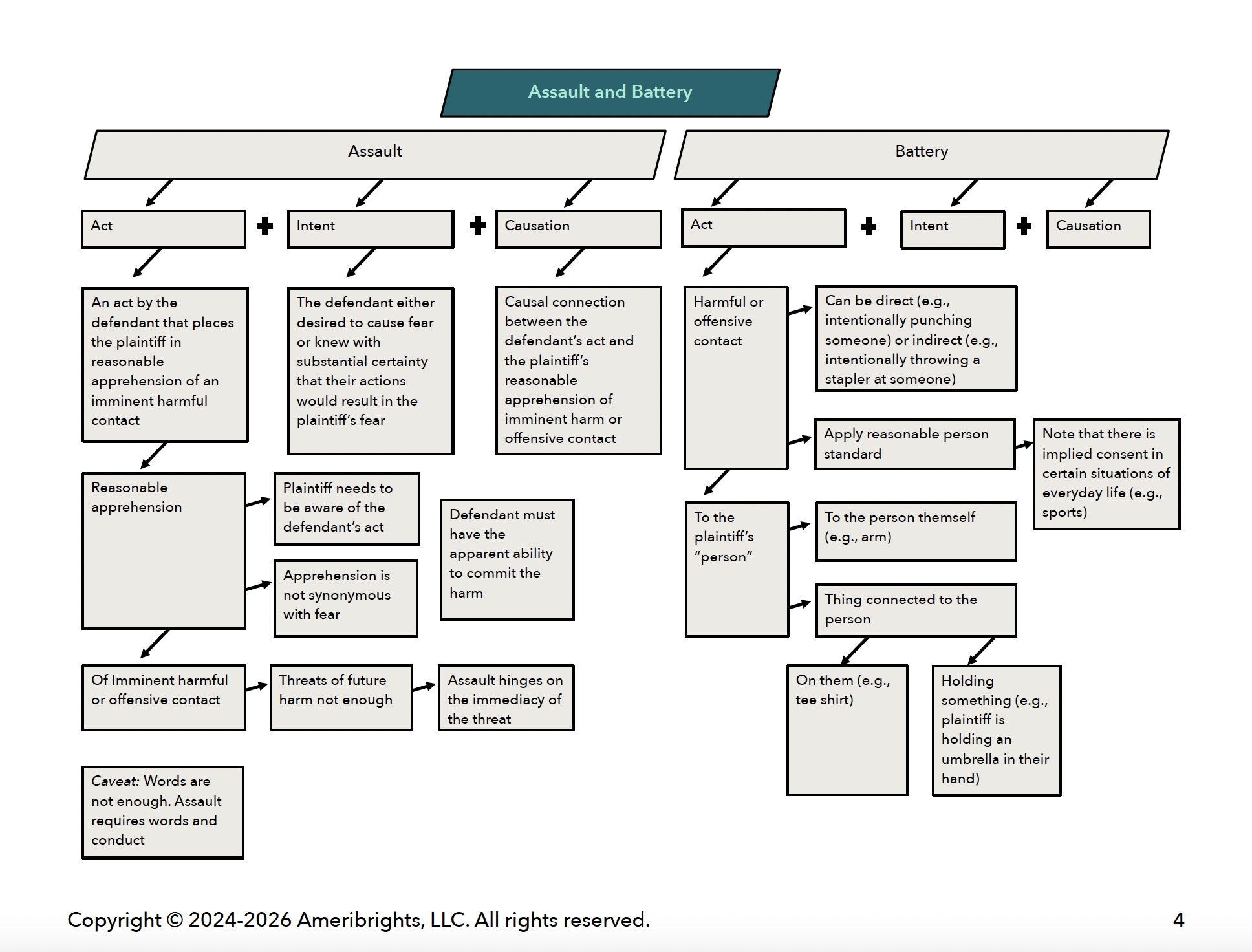
Sample Concept Map from Ameribrights Torts Maps
Sample Concept Map from Ameribrights Torts Map
Final Thoughts
This series is not about cutting corners. It’s about making decisions. The goal is not to study less; the goal is to study strategically and focus on what you can control.
The NCBE publishes subject matter outlines for a reason. Understanding where questions are concentrated can help you prioritize your study time and avoid treating every single topic as equally important.
In Part 3, we’ll wrap up the series with Contracts, Real Property, and Criminal Law and Criminal Procedure and examine one final set of NCBE testing patterns that can help guide your remaining study time.