
How to Study for the MBE In One Month
In this article
If you are preparing for the MBE—or sitting exclusively for Part B of the Florida Bar Exam—this article is for you.
In a perfect world, you’d have several months to sit down, digest the material, and study. But let’s be real—the world isn’t perfect.
Maybe you only got a month off from work. Maybe life happened with family obligations. Or maybe your focus and mental bandwidth just weren’t there earlier in the process.
Whatever the reason, it’s okay. You are not the first person to study on a shorter timeline, and you won’t be the last—and it definitely doesn’t mean you can’t pass.
When time is limited, passing isn’t about doing everything. It’s about taking the hours you do have and organizing them in an intentional way.
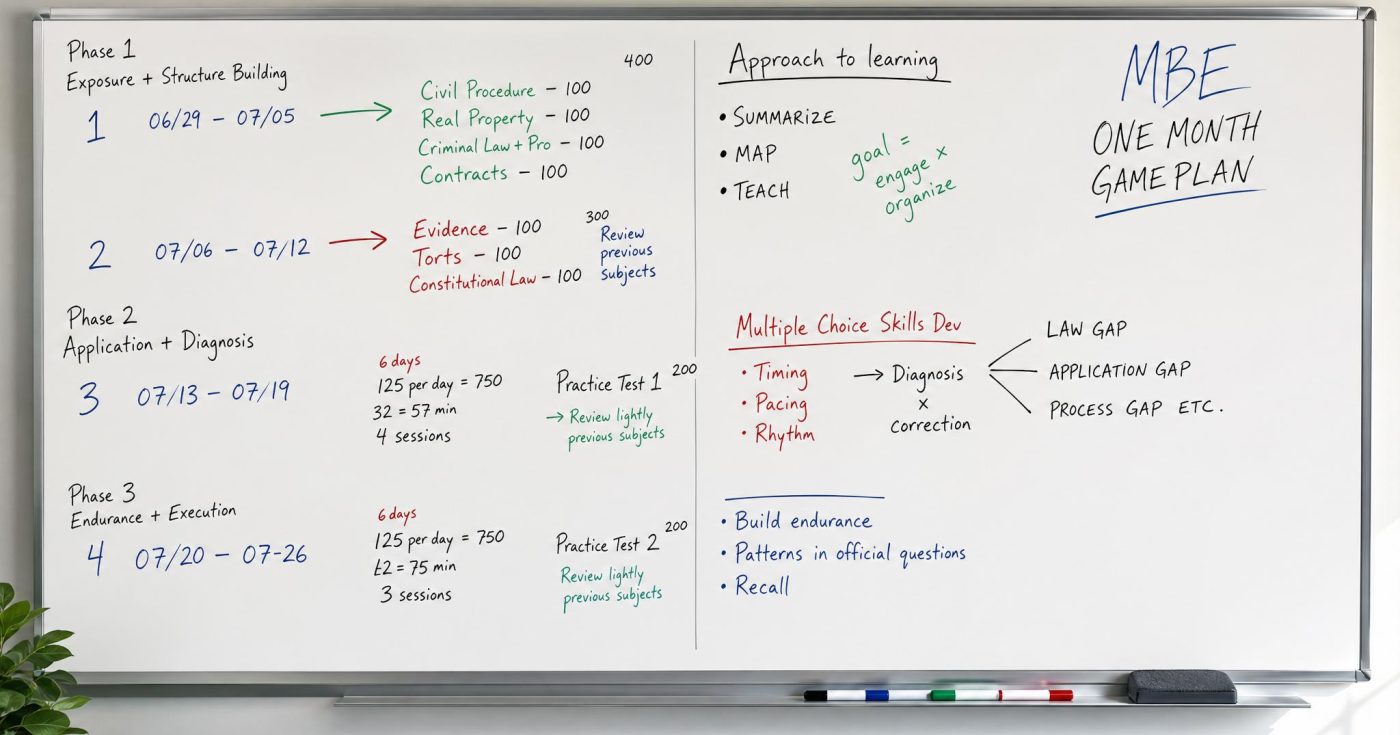
This is a suggested 3-phase study plan to help you structure your time, prioritize correctly, and walk into the exam with confidence.
Before You Begin: The Three Qualities That Matter Most
Before diving into the study plan, it is important to understand what a one-month timeline demands. This schedule is aggressive, and every study session has a purpose. While the timeline may be compressed, success is not determined by how many hours you study. It depends on how well you use the time you have.
Three qualities will matter more than anything else over the next month.
Discipline means holding yourself accountable to the plan you’ve committed to. It means protecting your time, eliminating unnecessary distractions, and refusing to let fear, self-doubt, or other people’s opinions pull your attention away from the work that needs to be done.
Execution is what ultimately determines your progress. Every practice question you review, every rule you actively recall, every essay you analyze, and every mistake you diagnose moves you forward. Reading alone is not enough. Improvement comes from consistently engaging with the law and applying it under exam conditions.
Resilience is your ability to adjust without losing momentum. There will be days when your scores disappoint you, a subject takes longer than expected, or life interrupts your schedule. Those moments are not signs that your plan has failed. They are opportunities to diagnose what happened, make the necessary adjustment, and continue moving forward.
The study plan that follows is designed to give you a clear framework for making the most of the next four weeks.
Phase 1: Exposure and Structure Building (Weeks 1 & 2)
The core goal of Phase One is simple: acquire the knowledge, lay your foundation, and build a clean mental structure of the material.
In the first two weeks, get through all 7 MBE subjects. Aim to tackle 4 subjects in the first week and the remaining 3 subjects in the second week.
- Week 1: Civil Procedure | Real Property | Criminal Law/Proc | Contracts
- Week 2: Evidence | Torts | Constitutional Law
This pace is a recommendation. If you move faster, great. If you go a bit slower, that’s fine too—this timeline builds in a cushion.
How to pair your subjects: How you organize these seven subjects depends entirely on your personal preference. If you want to get the hardest stuff out of the way first, frontload your weakest subjects in Week 1. However, if seeing a lower performance is going to negatively impact your mindset, mix your strong and weak subjects together each week so you don’t get discouraged. Pay attention to your own energy and structure it the way you need to. Also, don’t be afraid to pivot if you see the approach you planned for isn’t working.
Note: If you don’t already have a reliable source for black-letter law, use streamlined materials that prioritize structure over detail to lock down these concepts quickly.
Key Performance Indicators
To keep your momentum without burning out, track these clean, straightforward targets:
- Subject Coverage: Cross all 7 core subjects off your list by day 14.
- Question Volume: Aim for roughly 100 questions per subject, which breaks down to ~ 300 – 400 practice questions per week (about 700 total for Phase 1).
How to Learn (Strategies)
When you are limited on time, how you approach learning can be extremely important. The goal is not to passively read outlines, but to actively engage with the material so it actually sticks.
Just because someone else has been studying for three months does not mean they are learning more than you. It is entirely possible to sit at a desk for eight hours a day and passively absorb very little. With intentional strategies, one month of focused study can be significantly more effective than several months of passive reading.
If I were sitting for the bar exam today on a one-month timeline, these are the three strategies I would personally use:
Mind Maps
This is how you build structure. Before or during practice, create a visual layout of the law. For example, in Evidence, map how hearsay breaks down into its exemptions and exceptions. This creates a spatial framework that helps you navigate questions under pressure.
Summarizing
After each set of questions or a sub-topic, compress the material into one or two clear legal rules in your own words. The goal is to force your brain to reduce complexity into something retrievable.
Teaching (Talking Out Loud)
Explain the rule out loud as if you are teaching it to someone else. If you can clearly explain a concept without looking at notes, you understand it well enough for exam conditions.
Important Note
Don’t feel like you have to incorporate every strategy discussed here. There are many different ways to actively learn. The key is to find what works best for you, make sure you’re actively engaging with the material, and use your study time intentionally.
The Daily Review Cycle
Do not just do questions and move on to the next subject, or you will forget Week 1 by the time you hit Week 2. You need a system of constant verification.
Set aside an hour or two every evening strictly for review. But don’t just passively re-read your notes. Use this time to test your retention: pick a subject from a few days ago and see if you can still accurately sketch out its visual map or summarize its trickiest rules from memory. This active recall loop is what locks the material into your long-term memory.
Phase 2: Application + Diagnosis (Week 3)
Once you hit Week 3, the focus shifts. You are moving away from primarily acquiring knowledge and into applying the law under real exam pressure. This week is about getting practice with questions, sharpening timing, and learning exactly why you are missing questions.
Key Performance Indicators
A strong target for this week is:
- Daily Goal: Aim for about 125 MBE questions per day, 6 days this week.
- Weekly Target: This gives you roughly 750 MBE questions for the week.
- Baseline Benchmark: Cap off the week with one full-length 200-question practice test to see where you stand.
These numbers are simply targets. Adjust as you see fit. The goal is to increase timed exposure while still leaving enough energy to review your mistakes properly.
The Execution Strategy: Session Training
Do not sit down and try to answer 125 questions in one massive block.
Instead, break the day into sessions:
- 4 sessions of roughly 32 questions each
- 57 minutes per session
Each session trains you to work at the MBE suggested pace of approximately 1.8 minutes per question. More importantly, it gives you a feel for what an hour of focused MBE work actually feels like. You’ll develop the concentration, pacing, and mental endurance needed to maintain a consistent rhythm from the first question to the last.
Think of it like training at the gym. You don’t jump on the elliptical and expect to perform at your peak for an hour on the first day. You gradually build your endurance. These shorter, timed sessions allow you to develop that stamina in manageable blocks, preparing you for Phase Three, where you’ll begin combining those blocks into longer exam-like sessions that more closely mirror the actual MBE.
The Diagnosis & Review Strategy
The data you collect from these sessions and your practice test is extremely valuable—but only if you actually use it. Missing questions is normal. What matters is why you are missing them. You have to move past simply reading the answer explanation and thinking, “Okay, I get it now.” Instead, look under the hood and identify the actual blind spot that caused the miss in the moment.
To achieve this, try doing the following:
- Review everything, not just your mistakes: Many examinees review only the questions they get wrong, completely ignoring the ones they got right. By doing so, you miss half the dataset. Review your correct answers to ensure you got them right for the correct reason, not just a lucky guess.
- Deconstruct the answers for patterns: Especially when dealing with official NCBE questions, the patterns do not just exist in the facts—they appear heavily in the answer choices. Look closely at the wrong options. Start writing down the recurring traps you observe. Are the examiners shifting the burden of proof? Are they stating a correct rule but applying it to the wrong legal issue? When you start comparing questions and tracking these answer-choice mechanics, you begin to see the common forms of misdirection the examiners reuse across the entire test.
Generally, your MBE mistakes will start to cluster into distinct performance gaps such as:
- Law Gaps: The rule was unavailable, misremembered, or incomplete when you needed it.
- Application Gaps: The rule was available, but you misapplied it, skipped a step, took an analytical shortcut, or forced the facts toward a premature conclusion.
- Precision Gaps: You knew the law and saw the issue, but a reading mechanics error caused you to skip or gloss over a critical word, modifier, or phrase.
If you want to see exactly how to analyze these errors, check out I Got a 55% on My First Simulated MBE. Now What?. It breaks down these gaps in detail and shows you how to categorize your misses so you can build a targeted repair plan instead of wasting precious study hours throwing random fixes at the problem.
By the end of Phase Two, your goal is to have a much clearer picture of your timing, endurance, and answer choice patterns. That is what prepares you for the final stretch.
Phase 3: Endurance + Execution (Week 4)
In Phase 2, you built speed, rhythm, and identified your weaknesses. Phase 3 is about extending those same skills over longer periods so exam day feels familiar instead of exhausting. You are not letting your foot off the gas on volume; instead, you are changing how your practice is structured to prepare your mind and body for the exact endurance required on exam day.
Key Performance Indicators
You are sustaining the high-intensity volume from last week to lock in your stamina:
- Daily Goal: Continue hitting about 125 MBE questions per day, 6 days this week.
- Weekly Target: Another heavy stretch of roughly 750 MBE questions.
- Baseline Benchmark: Cap off the week with one final full-length 200-question practice test under strict exam conditions.
The Execution Strategy: Session Training (Building Endurance)
In Phase 2, you trained in short, punchy 32-question blocks to build speed. This week, we are changing how your practice is structured to build sustained focus and mental endurance. You need to train your brain to stay sharp for longer stretches without losing concentration.
Instead of four short sessions, break your 125 daily questions into 3 longer sessions:
- 3 sessions of roughly 41–42 questions each.
- Set a strict timer for 75 minutes per session.
By stretching your sessions to 75 minutes, you train your brain to maintain high-level analysis well past the one-hour mark. This directly prepares you for the physical and mental reality of the actual exam blocks.
Once you have completed your daily sessions, put it all together with your final 200-question simulation.
Treat this final simulated exam exactly like the real thing. Start at the same time you will on exam day, follow the scheduled breaks, eliminate distractions, and resist the urge to pause or check answers midway through. The goal is not just to test your knowledge—it is to rehearse your routine.
The Review Strategy: Pattern Reinforcement + Recall
Your review process this week is no longer about learning new material. It’s about reinforcing everything you’ve already built through three specific habits:
- Reviewing both your correct and incorrect answers to confirm your reasoning—not just the outcome.
- Looking for recurring patterns in both the fact patterns and the answer choices, especially in official NCBE questions.
- Practicing daily active recall by writing or reciting legal rules from memory without relying on your outlines.
By the end of Phase 3, the MBE should no longer feel unfamiliar. You’ll have trained your endurance, reinforced the patterns you’ve been seeing throughout your practice, and strengthened your ability to retrieve the law under pressure. At that point, your job is no longer to learn something new—it’s simply to execute the system you’ve spent the past month building.
Closing Thoughts
Preparing for the MBE in one month is a serious undertaking. It demands discipline, execution, and resilience. The timeline is compressed, but that simply means every study session carries a little more weight.
Over the course of the month, you’ll build far more than a study schedule. You’ll build a system. You’ll have organized the law, identified your weaknesses, strengthened your recall, and developed a process for turning mistakes into opportunities for improvement. At that point, your job is no longer to redesign your approach—it’s to trust it.
There will be moments when you leave a practice session feeling discouraged or wonder whether you’ve done enough. Don’t let one difficult day erase all the work you’ve been putting in. Evaluate what happened, make the necessary adjustment, and come back ready to execute the next study session.
When exam day arrives, there will almost certainly be questions you don’t know and moments of uncertainty. That’s part of every administration of the MBE. The goal was never to eliminate uncertainty—it was to prepare yourself to handle it.
Trust your preparation, stay disciplined, and focus on answering the question in front of you. Then move on to the next one.
Looking for additional support?
Our MBE study guides and concept maps are designed to help you move beyond passive review by combining active recall, plain-English explanations, visual frameworks, and highly tested distinctions into a single study system.